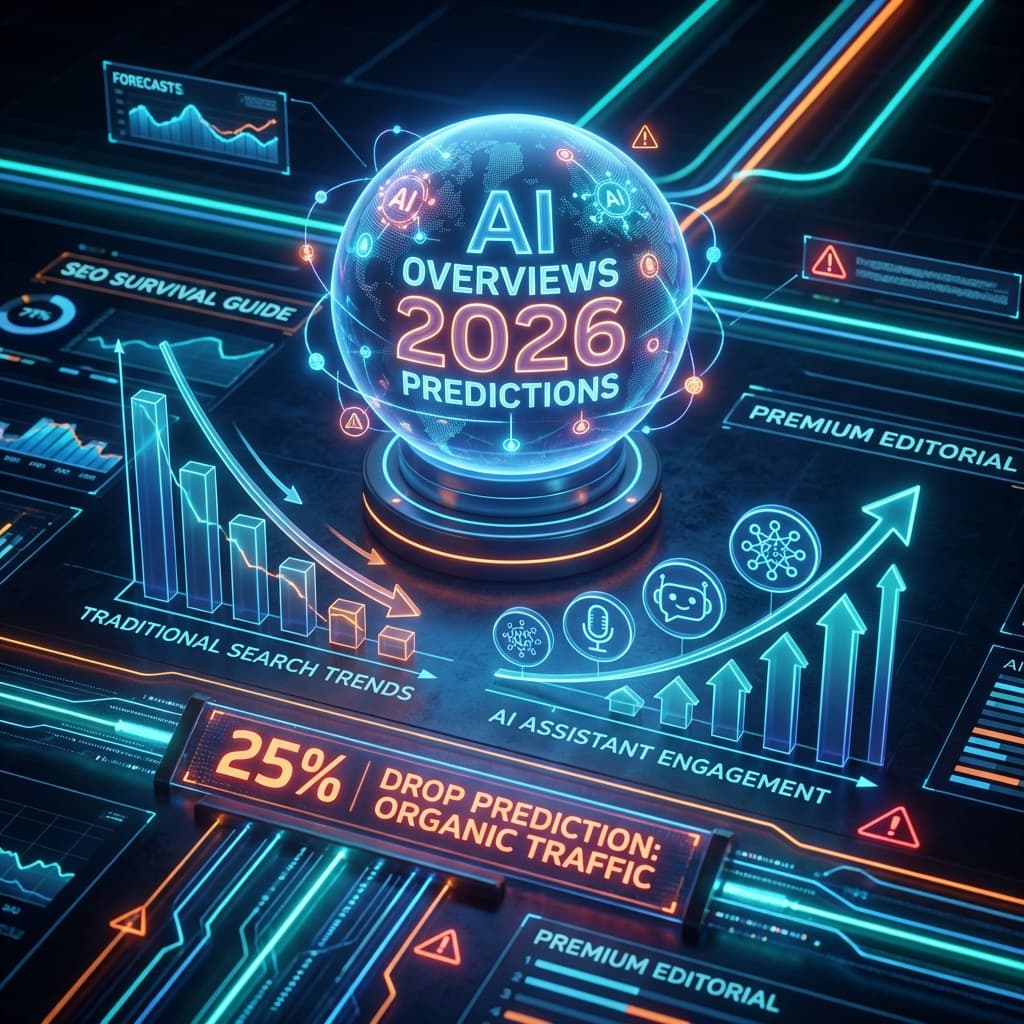
5 major AI search trends in 2026: (1) ChatGPT reaches 800M weekly users with 60-80% market share, (2) Google AI Overviews appear in 47% of searches, (3) traditional search traffic projected to drop 25% by year-end, (4) 58.5% of Google searches now end with zero clicks, and (5) conversational queries replace keyword-based searches.
AI search traffic grew 527% in 2025. The GEO tools market is projected to reach $33.68B by 2034.
This analysis covers the current state, 5 major trends, 12-18 month forecasts, and a 6-month preparation roadmap.
The State of AI Search in Early 2026
Market Share: The New Search Hierarchy
The AI search ecosystem has matured rapidly over the past 18 months, with clear market leaders emerging and adoption rates that have surprised even optimistic forecasters. According to recent market analysis, the current landscape looks dramatically different from traditional search:
ChatGPT maintains its dominant position with approximately 60-80% market share across various measurement methodologies. With 800 million weekly active users as of October 2025 and processing over 1 billion queries daily, ChatGPT has achieved a scale that positions it as a genuine alternative to Google for many use cases. The platform is projected to cross $6 billion in revenue in 2026, validating its commercial viability beyond experimentation.
Google AI Overviews have become ubiquitous in traditional search results, appearing in approximately 47% of searches as of mid-2025, with particularly high penetration for informational and how-to queries. More remarkably, 13.14% of all search queries now feature AI Overviews-a dramatic increase from just 6.49% earlier in 2025. This means more than 1 in every 8 searches delivers an AI-generated answer at the top of the results page, fundamentally changing user behavior and click-through patterns.
Perplexity AI has demonstrated explosive growth, expanding 524% in 2024 and now handling 780 million queries per month. With market share estimates ranging from 6.5-10.85%, Perplexity has carved out a significant niche among power users who value its real-time web integration and citation transparency. The platform is projected to reach $250-300 million in annual recurring revenue by Q4 2026.
Claude has steadily grown to 18.9 million monthly users, capturing approximately 3.5% market share. While smaller than its competitors, Claude's reputation for nuanced reasoning and safety-conscious responses has made it popular among professional users, particularly in legal, healthcare, and enterprise contexts.
Microsoft Copilot rounds out the top five with 14.1% market share, leveraging Microsoft's integration across Windows, Office, and Edge browser to drive adoption among existing enterprise customers.
User Adoption: The Behavioral Shift
The statistics on AI search adoption paint a clear picture: this isn't a temporary trend or novelty phase-it's a fundamental shift in information-seeking behavior.
Current projections indicate that AI will handle approximately 25% of all search queries by the end of 2026, with forecasts suggesting that number will reach 50% by 2028. The AI search engine market, valued at $43.6 billion in 2024, is projected to capture 62.2% of total search volume by 2030, with revenues approaching $379 billion.
Perhaps most striking is the zero-click trend: 58.5% of U.S. Google searches now end with zero clicks, as AI-generated responses satisfy user intent instantly. This represents a fundamental economic shift for both search engines and the websites that have historically benefited from search traffic.
Search Behavior Evolution
The way people use AI search differs fundamentally from traditional keyword-based queries:
Conversational queries have become the norm. Users increasingly phrase searches as natural questions or multi-part requests rather than keyword strings. "Best running shoes for marathon training with flat feet and budget under $150" is now a typical query, expecting a personalized, synthesized answer rather than a list of potentially relevant pages.
Session-based discovery is replacing one-off searches. Users engage in extended conversations with AI search tools, refining their questions, exploring tangential topics, and building on previous responses. This creates opportunities for brands to establish thought leadership across entire problem spaces rather than individual keywords.
Intent diversity has expanded beyond traditional search categories. Users now employ AI search for tasks ranging from data analysis and code generation to meal planning and emotional support-use cases that were never served well by traditional search engines.
5 Major Trends Shaping AI Search
1. Multi-Modal Search: Beyond Text
The future of search is emphatically multi-modal, seamlessly combining text, voice, images, and video into unified queries and responses. Google Lens alone processes over 12 billion visual searches each month, demonstrating massive demand for image-based discovery.
Why it matters: Multi-modal capabilities fundamentally change how users interact with search technology. A user can now photograph a restaurant dish and ask, "Find me a recipe for this, adapted for a vegan diet, with nutritional information." The query combines image recognition, contextual understanding, dietary preferences, and structured data retrieval in a single interaction.
Platform developments: All major AI search platforms have invested heavily in multi-modal capabilities. ChatGPT's vision features, Google's Lens integration with AI Overviews, and Perplexity's image understanding capabilities represent just the beginning. BrightEdge data shows a 121% increase in ecommerce-related YouTube citations for AI Overviews, indicating that video content is increasingly being parsed, understood, and referenced in AI-generated answers.
Content implications: For brands, this means thinking beyond text-based SEO. Every visual asset-product photos, infographics, diagrams, video content-must be optimized for AI interpretation. This requires:
- Descriptive, contextual alt text that explains not just what's in an image, but why it matters
- Video transcripts and captions that enable AI systems to extract key information
- Structured image data through schema markup
- High-quality visual content that clearly demonstrates concepts or products
A study from Digital Authority found that content with relevant images is 47% more likely to be cited in AI-generated responses compared to text-only content covering the same topic.
2. Real-Time Web Integration: The End of Stale Knowledge
Early AI chatbots were limited by their training data cutoff dates, creating a frustrating "knowledge gap" for any recent events or information. That limitation has rapidly disappeared as platforms integrate real-time web search capabilities.
Platform evolution: Perplexity built its entire value proposition around real-time web citations. ChatGPT's web browsing feature, initially experimental, has become standard functionality. Even Claude, traditionally focused on parametric knowledge, is increasingly being deployed in retrieval-augmented generation (RAG) systems that combine its reasoning capabilities with current web data.
Impact on brand visibility: Real-time integration fundamentally changes the game for brand visibility. Your content can now influence AI responses within hours or even minutes of publication, rather than waiting months for the next model training cycle. This creates both opportunity and pressure: brands that publish timely, high-quality content gain immediate citation potential, while outdated or inaccurate information can hurt visibility just as quickly.
Research indicates that AI search platforms favor content published within the last 90 days for time-sensitive queries, with recency serving as a significant citation factor for news, trends, and evolving topics.
Strategic implications: Brands must shift from treating content as a one-time publication to maintaining living, updated resources. Regular content audits, fact updates, and freshness signals become critical. The concept of "evergreen content" is evolving-it's no longer sufficient for content to be theoretically timeless; it must be demonstrably current.
3. Personalization and Context-Aware Responses
AI search platforms are moving beyond one-size-fits-all answers to deliver responses tailored to individual user contexts, expertise levels, and intent signals.
How it works: Modern AI search systems consider multiple contextual factors:
- User expertise: The same query about "quantum computing" receives different answers depending on whether the user's history suggests they're a student, researcher, or curious generalist
- Location and culture: Regional preferences, local regulations, and cultural context shape recommendations
- Search history and preferences: Previous interactions inform the depth, format, and focus of responses
- Device and situation: Mobile users often receive more concise, action-oriented answers compared to desktop users engaged in research
Brand implications: This trend creates both challenges and opportunities. On one hand, there's no single "ranking" to optimize for-your content might be featured prominently for one user and not mentioned for another asking the same question. On the other hand, brands can be more strategic about the specific user segments they target, creating content optimized for particular experience levels, regions, or use cases.
According to Digital Authority research, personalization means "curating information delivery based on user needs, skill levels (beginner vs. expert), funnel progression, and relevant subtopics-meeting users where they are with tailored, appropriate content."
Optimization strategies: To succeed in a personalized search environment:
- Create content at multiple sophistication levels for the same topic
- Use clear indicators of intended audience (beginners, intermediates, experts)
- Provide comprehensive coverage that serves various user intents
- Build topical authority across related subjects to increase citation probability across contexts
4. Voice-First AI Search Adoption
While voice assistants like Alexa and Siri dominated the 2010s, the integration of generative AI capabilities is creating a new wave of voice-first search adoption with fundamentally different characteristics.
The evolution: Early voice assistants were limited to simple commands and structured queries. Today's AI-powered voice search handles complex, multi-turn conversations with contextual understanding. Apple's integration of ChatGPT into Siri represents a watershed moment, bringing conversational AI capabilities to hundreds of millions of devices.
Usage patterns: Voice search already shows distinct patterns from text queries:
- Longer, more natural phrasing ("What are the best restaurants near me that serve gluten-free options and are open late on weekends?")
- Local intent bias (70% of voice searches have local intent)
- Action-oriented queries focused on immediate needs
- Higher purchase intent in commercial categories
Interestingly, the relationship between traditional voice assistants and generative AI is complex. Market analysis notes that "conversational, contextual, and multimodal AI tools, such as ChatGPT, have pushed voice-first assistants out of the running-for now, at least." Users are increasingly opting to type into ChatGPT or Perplexity rather than speaking to Alexa or Google Assistant, suggesting that conversational capability matters more than voice interface alone.
Content optimization: Voice-optimized content requires:
- Natural language structure that mirrors how people speak
- Direct answers to common questions in the first 100 words
- Local relevance signals for businesses with physical presence
- FAQ formats that address conversational query patterns
5. Enterprise AI Search Tools
While consumer-facing AI search has dominated headlines, the rapid growth of enterprise-specific AI search tools represents one of 2026's most significant developments.
The enterprise shift: Organizations are deploying internal AI search systems that can query across proprietary databases, document repositories, customer relationship management systems, and the broader web. These tools combine the conversational interface of consumer AI search with enterprise security, compliance, and integration requirements.
Market dynamics: Microsoft Copilot for Microsoft 365, Google's enterprise AI search capabilities in Workspace, and specialized enterprise search platforms from companies like Glean, Hebbia, and Coveo are seeing rapid adoption. The enterprise AI search market is projected to grow from $7.2 billion in 2024 to $28.6 billion by 2028, representing a 41% compound annual growth rate.
Brand implications: Enterprise AI search creates a parallel visibility challenge. While consumer-facing GEO focuses on platforms like ChatGPT and Perplexity, enterprise GEO requires ensuring your brand appears in responses generated by corporate AI systems. This often means:
- Creating content specifically designed for B2B decision-makers
- Establishing authoritative presence in industry publications that enterprise AI systems prioritize
- Developing case studies, whitepapers, and technical documentation that demonstrate expertise
- Building relationships with industry analysts whose assessments influence enterprise AI training data
Research indicates that enterprise AI search systems weight authoritative industry sources up to 3x more heavily than consumer-focused systems, making thought leadership and industry participation critical for B2B brands.
What's Coming in 2026-2027: Platform Predictions
New Features and Expansions
ChatGPT's evolution: OpenAI is expected to launch more sophisticated web browsing capabilities, including real-time data visualization, interactive content generation, and deeper integration with third-party data sources. The platform's move toward multi-modal understanding-combining text, images, audio, and potentially video in single conversations-will expand the types of content that influence citations.
Industry observers anticipate ChatGPT will introduce sponsored citation opportunities in Q2-Q3 2026, allowing brands to pay for preferred placement in relevant responses while maintaining clear disclosure. This would represent a significant monetization shift and create new paid visibility channels similar to traditional search advertising.
Google's AI integration deepening: Google is expected to expand AI Overviews to cover 60-75% of search results by late 2026, with increasingly sophisticated multi-modal capabilities. The integration of Google's Gemini model across Search, Maps, YouTube, and Shopping will create a unified AI discovery experience spanning Google's entire ecosystem.
Notably, Google's Code of Practice for AI-generated content labeling, developed in response to EU AI Act requirements, may become an industry standard that other platforms adopt, creating new transparency norms around AI-generated vs. human-created content.
Perplexity's enterprise push: Perplexity is positioning itself as the "professional" AI search platform, with anticipated launches of Perplexity for Business, enhanced API access for enterprise integration, and deeper partnerships with industry-specific data providers. The platform's focus on citation transparency and real-time accuracy makes it attractive for professional users in research, journalism, and business intelligence roles.
New entrants: Several well-funded startups are building next-generation AI search platforms with specific differentiators:
- You.com and Phind focus on developer and technical audiences with code-aware search
- Metaphor (now Exa) specializes in semantic search that understands conceptual relationships
- Andi emphasizes conversational search with privacy protections
While none are likely to challenge ChatGPT or Google's dominance in 2026, they represent important niche opportunities for brands targeting specific professional audiences.
Technology Developments
Better RAG architectures: Retrieval-Augmented Generation continues to evolve rapidly. According to industry research, "RAG reduces stale model memory and lowers hallucination risk by grounding responses in up-to-date sources."
Expected improvements in 2026-2027 include:
- Hybrid search combining semantic understanding with keyword precision
- Multi-source verification that cross-references claims across multiple documents
- Dynamic retrieval that adjusts sources based on query specificity
- Temporal awareness that prioritizes recent information for time-sensitive topics
Longer context windows: The rapid expansion of context windows-from 4K tokens in early ChatGPT to 200K+ in current models-enables AI systems to process entire documents, research papers, or website sections in a single query. By late 2026, context windows of 1M+ tokens are expected to become standard, fundamentally changing how AI systems understand and synthesize information.
For brands, this means:
- Comprehensive, long-form content becomes more valuable as AI systems can process and extract insights from 10,000+ word guides
- Internal content consistency matters more, as AI systems can identify contradictions across different pages
- Site architecture and information hierarchy become citation factors, as AI systems process multiple pages to form holistic understanding
Real-time data integration: The gap between web publishing and AI system awareness continues to shrink. Early 2026 systems already achieve citation latency of 15-30 minutes for breaking news. By 2027, expect near-real-time integration, where high-authority content can influence AI responses within minutes of publication.
This creates both opportunity and risk: brands can gain immediate visibility for timely content, but errors, outdated information, or controversies propagate just as quickly through AI systems.
Regulatory Impacts
EU AI Act implementation: The AI Act's transparency rules take effect August 2, 2026, creating the first comprehensive regulatory framework for AI systems including search platforms. Key requirements include:
Copyright compliance: Article 53(1)(c) requires AI model providers to implement policies ensuring EU copyright law compliance, particularly respecting rights holders who opt-out. Training data disclosure requirements mandate that AI companies publish summaries of content used for training, including data sources and processing methods.
For brands, this creates new opportunities:
- Rights reservation mechanisms allow companies to control whether their content trains AI models
- Disclosure requirements provide visibility into which sources AI systems prioritize
- Copyright enforcement mechanisms create leverage for ensuring proper attribution
Content labeling: AI-generated content labeling requirements become mandatory in August 2026, requiring machine-readable markers on AI-generated text, images, and videos. This regulation may accelerate the distinction between AI-generated and human-expert content, potentially creating premium value for verified human authorship in certain contexts.
Global ripple effects: While the AI Act applies to the EU, its extraterritorial scope and Brussels Effect-where companies adopt EU standards globally-mean these regulations will likely influence AI search platforms worldwide. Similar regulatory frameworks are under consideration in the U.S., UK, and other markets.
Monetization Models
The AI search industry is rapidly evolving from experimental free tools to commercially sustainable platforms, creating new dynamics for brand visibility.
Subscription tiers: ChatGPT Plus, Perplexity Pro, and similar premium tiers have proven willingness to pay for enhanced AI search capabilities. By 2026, tiered access models are expected across most platforms, with premium users receiving:
- Longer context windows and more sophisticated reasoning
- Priority access to newest features and models
- Enhanced privacy and data control
- Commercial use rights for generated content
Sponsored citations: The most significant development for brands will be the introduction of paid placement in AI-generated responses. Unlike traditional search ads, sponsored citations will likely appear as:
- Labeled preferred recommendations within responses
- Sponsored follow-up questions that guide users toward specific brands
- Promoted sources in citation lists
- Featured content in specific query categories
Industry estimates suggest this market could reach $15-20 billion by 2028, creating substantial new paid visibility channels.
API commercialization: As businesses integrate AI search capabilities into their own products, API access becomes a major revenue stream. For brands, this creates opportunities to ensure visibility across both direct consumer interactions and embedded AI search experiences within third-party platforms.
How These Trends Impact GEO Strategy
Content Format Evolution
The rise of multi-modal AI search fundamentally changes what constitutes "optimized content." Text-only optimization is no longer sufficient; brands must think in terms of comprehensive information packages that AI systems can process across formats.
Visual optimization becomes mandatory: Every image, infographic, diagram, and video must be created with AI interpretation in mind. This means:
- Descriptive, contextual image elements: Rather than generic alt text like "product photo," effective visual optimization requires context: "Woman wearing waterproof running shoes on wet trail, showing grip and ankle support features"
- Structured visual information: Charts, graphs, and infographics should include underlying data in machine-readable formats (schema markup, data tables) so AI systems can extract and recombine information
- Video content with comprehensive metadata: Transcripts, chapter markers, key concept timestamps, and visual descriptions enable AI systems to extract relevant information without "watching" entire videos
Interactive and dynamic content: AI systems increasingly favor content that demonstrates concepts interactively. Calculators, configurators, comparison tools, and interactive visualizations signal comprehensive coverage of topics and provide AI systems with structured data about relationships, ranges, and options.
Structured data as a foundation: Schema markup has evolved from an SEO nice-to-have to a GEO fundamental. AI systems heavily rely on structured data to understand:
- Entity relationships (brands, products, people, organizations)
- Content type and purpose (how-to, recipe, product, review)
- Specific attributes (price, availability, specifications)
- Authorship and expertise signals
Research indicates that content with comprehensive schema markup is 73% more likely to be cited by AI search platforms compared to equivalent content without structured data.
Technical Requirements
Site architecture for AI crawling: While traditional SEO focused on helping search engines discover and rank individual pages, GEO requires facilitating AI systems' holistic understanding of your content ecosystem. This means:
- Logical information hierarchy: Clear category structures, topic clusters, and internal linking patterns that help AI systems understand topical relationships
- Comprehensive internal linking: Strategic links between related content enable AI systems to gather comprehensive information across multiple pages
- Clean, semantic HTML: Proper heading hierarchies, semantic tags, and ARIA labels improve AI content extraction accuracy
- API and data access: Some advanced GEO strategies involve providing direct API access to product data, documentation, or knowledge bases that AI systems can query
Performance and accessibility: AI systems increasingly factor user experience signals into citation decisions. Sites that load quickly, work well on mobile devices, and meet accessibility standards are more likely to be referenced, as AI platforms aim to recommend resources that users can actually access and use effectively.
Content freshness infrastructure: Real-time AI integration means content publication and update velocity matters. Technical infrastructure that enables:
- Rapid content publication and indexing
- Frequent updates to existing content with clear change tracking
- Automatic freshness signals (last updated dates, change logs)
- Version control for critical information
Brand Building Approaches
Traditional SEO often focused on specific keyword rankings; GEO requires building holistic brand authority that makes your organization a default source across entire topic areas.
Domain authority still matters, differently: While "Domain Authority" as a specific metric may be less relevant, the underlying concept-that AI systems trust and cite authoritative sources more frequently-remains critical. However, authority in the AI era is built through:
Thought leadership and original research: AI systems value content that provides unique insights, original data, or novel perspectives. According to industry research, "brand mentions can be increased across the web through guest blogging, thought leadership, and authentic community engagement, which helps establish authority and improves citation likelihood in AI responses."
Publishing original research, industry surveys, expert analysis, or proprietary data creates citation magnets-content that AI systems reference because it's the only source for specific information.
Expert authorship and E-E-A-T signals: The expertise, experience, authoritativeness, and trustworthiness framework Google developed for Search Quality Raters has become even more critical for AI systems. Clear author credentials, expert backgrounds, editorial standards, and fact-checking processes all contribute to citation probability.
Multi-platform presence: AI systems aggregate information across sources. Brands that maintain consistent, high-quality presence across:
- Their own website and blog
- Industry publications and trade media
- Professional platforms (LinkedIn, industry forums)
- Academic and research repositories
- News and mainstream media
...create multiple citation pathways that reinforce authority.
Community and conversation: Unlike traditional search engines that primarily crawl static web pages, AI systems increasingly process discussion forums, social media threads, Reddit conversations, and community platforms. Active, authentic participation in relevant communities-without overt self-promotion-builds organic brand mentions that influence AI citations.
Measurement Frameworks
One of GEO's most significant challenges is the lack of standardized measurement frameworks comparable to traditional SEO metrics like rankings, organic traffic, and conversions.
AI visibility metrics: New measurement approaches are emerging:
Citation frequency: Specialized GEO tools like OmniSEO®, Otterly.ai, Rankscale, and Ahrefs Brand Radar track how often your brand appears in AI-generated responses across various query types. This provides a baseline visibility metric analogous to keyword rankings.
Citation position and context: Not all citations are equal. Tools measure:
- Primary recommendation (your brand as the top suggestion)
- Alternative option (mentioned alongside competitors)
- Contextual mention (referenced as an example or for specific features)
- Citation absence (competitor mentioned but you're not)
Sentiment and recommendation strength: Advanced analysis evaluates how favorably AI systems present your brand:
- Positive sentiment (enthusiastic recommendation)
- Neutral presentation (factual mention)
- Negative context (mentioned as counter-example or with caveats)
- Recommendation strength (must-have vs. option to consider)
Share of voice across engines: Tracking visibility across ChatGPT, Perplexity, Claude, Google AI Overviews, and other platforms provides a comprehensive picture of AI search presence.
Attribution and conversion tracking: Measuring actual business impact from AI search remains challenging, as most platforms don't pass referral data. Emerging approaches include:
- Survey mechanisms asking customers how they discovered you
- Unique URLs or promotion codes mentioned in key content likely to be cited
- Brand search lift analysis (increase in direct brand searches correlated with AI visibility)
- Assisted conversion modeling that accounts for AI touchpoints in customer journeys
How to Prepare Your Brand: The 6-Month Roadmap
Month 1: Audit Current AI Visibility
Baseline assessment: Before optimizing for AI search, understand where you stand today.
Manual testing: Systematically query ChatGPT, Perplexity, Claude, and Google (to trigger AI Overviews) with:
- Direct brand queries ("Tell me about [your company]")
- Category searches ("Best [product category] for [use case]")
- Comparison queries ("Compare [your brand] vs [competitor]")
- Problem-solving searches ("How to [solve problem your product addresses]")
Document every instance where your brand is mentioned, how it's characterized, and how it compares to competitor visibility.
GEO tool implementation: Deploy specialized tracking tools like OmniSEO®, Otterly.ai, or Rankscale to automate and scale visibility monitoring. These tools provide:
- Automated query testing across dozens or hundreds of relevant searches
- Competitive benchmarking against your key rivals
- Historical tracking to measure visibility changes over time
- Alert systems for significant visibility shifts
Citation analysis: For every instance where your brand is cited, analyze:
- What specific content was the source? (Can you identify the page or document AI systems referenced?)
- How is your brand characterized? (Sentiment, positioning, recommendation strength)
- What context triggers your mentions? (Specific use cases, features, or comparisons)
- Where are the citation gaps? (Queries where competitors appear but you don't)
Month 2: Update Content Infrastructure
Foundation building: Use insights from your audit to prioritize infrastructure improvements.
Schema markup implementation: Audit existing structured data and expand coverage:
- Organization schema with comprehensive brand information
- Product schema with detailed specifications, pricing, availability
- Article schema with author credentials, publication dates, update tracking
- HowTo and FAQ schema for instructional content
- Review and rating schema for social proof
Tools like Google's Structured Data Testing Tool or Schema.org validators help identify and fix implementation errors.
Content freshness system: Implement processes to maintain current information:
- Last updated dates on all content with clear visibility
- Regular content audit schedules (quarterly for evergreen content, weekly or daily for time-sensitive topics)
- Change logs for significant updates to key resources
- Automated alerts for outdated statistics, broken links, or deprecated information
Multi-modal content enhancement: Identify high-value content that would benefit from visual enhancement:
- Add diagrams, infographics, or process visualizations to complex topics
- Create video explanations or demonstrations for hands-on subjects
- Develop interactive tools, calculators, or configurators for decision-making content
- Ensure all visual content has descriptive, contextual alt text and captions
Technical optimization: Address technical barriers to AI crawling:
- Improve site speed (Core Web Vitals compliance)
- Ensure mobile responsiveness and accessibility
- Fix broken links and eliminate orphaned pages
- Create XML sitemaps specifically for AI-relevant content
- Implement clear heading hierarchies and semantic HTML
Month 3: Build Brand Authority
Content strategy refinement: Shift from keyword-focused content to authority-building resources.
Original research initiatives: Plan and execute research projects that create citation-worthy assets:
- Industry surveys with unique data
- Case study analyses of customer success
- Experimental testing or comparisons
- Trend analysis based on proprietary data
- Expert roundup insights
Thought leadership development: Position key team members as industry experts:
- Regular publication on company blog with strong author bios
- Guest contributions to industry publications
- Speaking engagements at conferences (with content distribution of presentations)
- Podcast appearances and interviews
- LinkedIn thought leadership with substantive, shareable insights
Citation building: Systematically increase brand mentions across the web:
- Guest blogging on authoritative industry sites
- Expert quotes for journalist requests (HARO, Featured, Connectively)
- Participation in industry forums and communities
- Collaboration with complementary brands on co-created content
- Sponsorship or support of industry research and reports
Link building with AI context: Traditional link building remains valuable, but prioritize links from:
- High-authority domains that AI systems frequently cite
- Industry-specific resources and publications
- Educational and research institutions
- News and journalism platforms
- Expert and professional communities
Month 4: Implement Tracking Systems
Measurement infrastructure: Establish systematic visibility tracking.
GEO dashboard creation: Build a centralized tracking system that monitors:
- Brand citation frequency across key platforms (weekly or bi-weekly checks)
- Visibility for priority query categories (decision-stage, discovery, comparison)
- Competitive benchmarking metrics
- Sentiment and recommendation strength trends
- Share of voice analysis
Attribution methodology: Develop approaches to connect AI visibility to business outcomes:
- Survey integration asking new customers about discovery sources
- UTM parameter strategies for trackable content links
- Brand search volume monitoring for lift correlation
- Assisted conversion modeling in analytics platforms
Alert systems: Configure notifications for:
- Significant visibility changes (positive or negative)
- New competitive mentions or positioning shifts
- Negative sentiment or factual errors about your brand
- Citation opportunities (queries where you should appear but don't)
Reporting frameworks: Create regular reporting cadences:
- Weekly internal alerts for significant changes
- Monthly comprehensive GEO performance reports
- Quarterly strategic reviews with trend analysis and recommendations
Month 5: Content Optimization and Expansion
Strategic content development: Use data from previous months to guide new content creation.
Gap filling: Create content for high-value queries where competitors currently dominate:
- Identify competitor citation sources and create superior alternatives
- Develop content for search intents where your brand is absent
- Build comprehensive resources for important buyer journey stages
Content format diversification: Expand beyond text-only content:
- Video tutorials and product demonstrations
- Interactive tools and resources
- Downloadable guides and templates
- Comparison matrices and decision frameworks
- Case study libraries with diverse industries and use cases
Depth over breadth: AI systems favor comprehensive, authoritative resources over thin content. Prioritize:
- Long-form guides (3,000-10,000+ words) covering topics exhaustively
- Multi-part content series that establish sustained topical authority
- Regular updates to cornerstone content with new insights and data
Expertise showcase: Make credentials and expertise explicit:
- Detailed author bios with relevant credentials and experience
- Clear attribution of facts to credible sources
- Transparent methodology for research and analysis
- Editorial standards and fact-checking processes documentation
Month 6: Ongoing Optimization and Strategy Refinement
Continuous improvement: Establish sustainable processes for long-term GEO success.
Performance analysis: Review six months of data to identify:
- Which content types and formats drive highest citation rates?
- What topics or query types show strongest visibility?
- Which platforms provide best ROI for optimization effort?
- Where do competitive gaps remain?
Strategy iteration: Refine approach based on learnings:
- Double down on high-performing content types and topics
- Deprioritize or sunset low-impact content
- Adjust resource allocation across platforms based on visibility and business value
- Update editorial calendars with proven content formats
Testing and experimentation: Implement structured testing:
- A/B test different schema markup approaches
- Experiment with content depth (does 5,000 words outperform 2,000 for specific topics?)
- Test author credential visibility and format
- Trial different citation building strategies and measure impact
Team development and process refinement: As GEO matures within your organization:
- Document best practices and playbooks
- Train content creators on AI-optimized content development
- Integrate GEO considerations into content planning workflows
- Establish cross-functional collaboration between content, SEO, and brand teams
Platform monitoring: Stay current with AI search platform developments:
- Track new feature launches and assess implications
- Monitor regulatory changes affecting AI search
- Watch competitive GEO strategies for innovation and differentiation opportunities
- Adjust strategy as platform capabilities and user behaviors evolve
The Preparation Checklist
Use this comprehensive checklist to ensure your brand is prepared for the AI search landscape of 2026 and beyond:
Foundation (Must-Have)
- Comprehensive schema markup implemented across site (Organization, Product, Article, FAQ, HowTo)
- Content freshness system with last-updated dates and regular audit schedules
- Baseline AI visibility audit completed across ChatGPT, Perplexity, Claude, Google AI Overviews
- Technical SEO optimized (site speed, mobile responsiveness, accessibility, semantic HTML)
- GEO tracking tool implemented for ongoing visibility monitoring
Content Excellence (High Priority)
- All visual content has descriptive, contextual alt text
- Key pages include video, interactive, or visual elements beyond text
- Author credentials and expertise clearly displayed on content
- Fact-checking and source attribution implemented
- Top 10 cornerstone content pieces comprehensively updated
- Original research or proprietary data published
- Content covers multiple expertise levels (beginner to advanced) for key topics
Authority Building (Ongoing)
- Guest publication strategy with target publications identified
- Thought leadership calendar established with regular publishing cadence
- Community engagement plan for relevant industry forums and platforms
- Expert positioning strategy for key team members
- Citation building outreach program initiated
- Brand mention monitoring system active
Measurement and Optimization (Essential)
- GEO performance dashboard created with key metrics
- Competitive benchmarking framework established
- Alert systems configured for visibility changes
- Attribution methodology defined and implemented
- Regular reporting cadence established (weekly, monthly, quarterly)
- Testing and experimentation framework developed
Platform-Specific (Advanced)
- Platform-specific optimization for ChatGPT, Perplexity, Claude, Google AI Overviews
- Voice search optimization for conversational queries
- Local optimization for location-based queries (if applicable)
- Enterprise AI search considerations for B2B brands
- Multi-language and regional content strategy (if global)
Compliance and Risk Management (Regulatory)
- Content rights and usage policies established
- EU AI Act compliance review (particularly for European operations)
- Copyright attribution and licensing clear on all content
- AI-generated content labeling strategy (if using AI in content creation)
- Brand monitoring for misinformation or negative sentiment in AI responses
Frequently Asked Questions
How much of search traffic will AI handle by 2026?
AI is projected to handle approximately 25% of all search queries by the end of 2026, with forecasts suggesting 50% by 2028. Traditional search volume is predicted to drop 25% by 2026 due to AI chatbots and virtual agents. ChatGPT alone processes over 1 billion queries daily with 800 million weekly active users.
Which AI search platform should I prioritize for GEO?
ChatGPT should be your primary focus with 60-80% market share and 92% Fortune 500 adoption. Perplexity (6.5-10.85% market share, 780 million queries/month) is essential for research-focused audiences and technical buyers. Claude (3.5% market share) matters most for regulated industries and enterprise contexts. Google AI Overviews appear in 47% of searches and are critical for traditional search visibility.
Is traditional SEO still relevant with AI search growing?
Yes—both channels serve different intents. Google excels for transactional queries, local searches, and e-commerce browsing. AI search dominates for exploratory queries, solution discovery, and strategic research. The content you create for SEO can serve both channels with optimization tweaks. Maintain strong traditional SEO while adding GEO tactics—many successful strategies share 70-80% of the same content.
How will the EU AI Act affect AI search optimization?
The EU AI Act's transparency rules take effect August 2, 2026. Key impacts include training data disclosure requirements, copyright compliance obligations, and AI-generated content labeling mandates. This creates opportunities: rights reservation mechanisms let companies control whether their content trains AI models, and disclosure requirements provide visibility into which sources AI systems prioritize.
What content formats work best for AI citations in 2026?
Content with relevant images is 47% more likely to be cited versus text-only content. Comprehensive schema markup increases citation probability by 73%. AI systems favor long-form guides (3,000-10,000+ words), original research with proprietary data, multi-modal content (video, interactive tools, visualizations), and content with clear author credentials and E-E-A-T signals. Update content regularly—AI platforms favor content published within the last 90 days for time-sensitive queries.
How do I prepare my brand for AI search changes in the next 6 months?
Follow the 6-month roadmap: Month 1—audit current AI visibility across ChatGPT, Perplexity, Claude, and Google AI Overviews. Month 2—update content infrastructure with schema markup and freshness systems. Month 3—build brand authority through original research and thought leadership. Month 4—implement GEO tracking and measurement systems. Month 5—expand content strategically based on gap analysis. Month 6—optimize based on performance data and establish sustainable processes.
Looking Ahead: The AI Search Imperative
The transformation we're witnessing isn't a temporary disruption-it's a fundamental shift in how information discovery works. Gartner predicts search engine volume will drop 25% by 2026 due to AI chatbots and virtual agents. This isn't a replacement of search; it's an evolution to a more conversational, contextual, and personalized discovery experience.
For brands, this creates an imperative: adapt or become invisible. Traditional SEO remains important-Google's traditional search still drives massive traffic and conversions-but it's no longer sufficient. As industry analysis notes, "Generative Engine Optimization (GEO) will be impossible to ignore in 2026 as generative AI reshapes how people discover answers and how brands get found."
The opportunity is significant for brands that move quickly. AI search platforms are still establishing their citation patterns and authority signals. Early movers who build comprehensive content libraries, establish topical authority, and implement technical infrastructure gain compounding advantages as AI systems increasingly reference their historical content and brand presence.
The challenge is equally significant. AI search fundamentally changes the economics of content and discovery. Zero-click results mean fewer website visits. AI-synthesized answers mean less direct brand engagement. Traditional metrics like rankings and organic traffic become less relevant or predictable.
Success in this environment requires a mindset shift: from optimizing for rankings to building genuine authority, from keyword targeting to comprehensive topic coverage, from one-time content creation to ongoing information stewardship, and from channel-specific tactics to integrated brand building.
The brands that will thrive in the AI search era are those that commit to being the best, most authoritative, most comprehensive source of information in their domains. Not just for search engines-artificial or traditional-but for the humans they ultimately serve.
The future of search is here. The question isn't whether to prepare-it's how quickly you can adapt.
Ready to see where you stand? Get your AI Visibility Audit — $499 one-time report with your score, competitor comparison, and 90-day action plan.