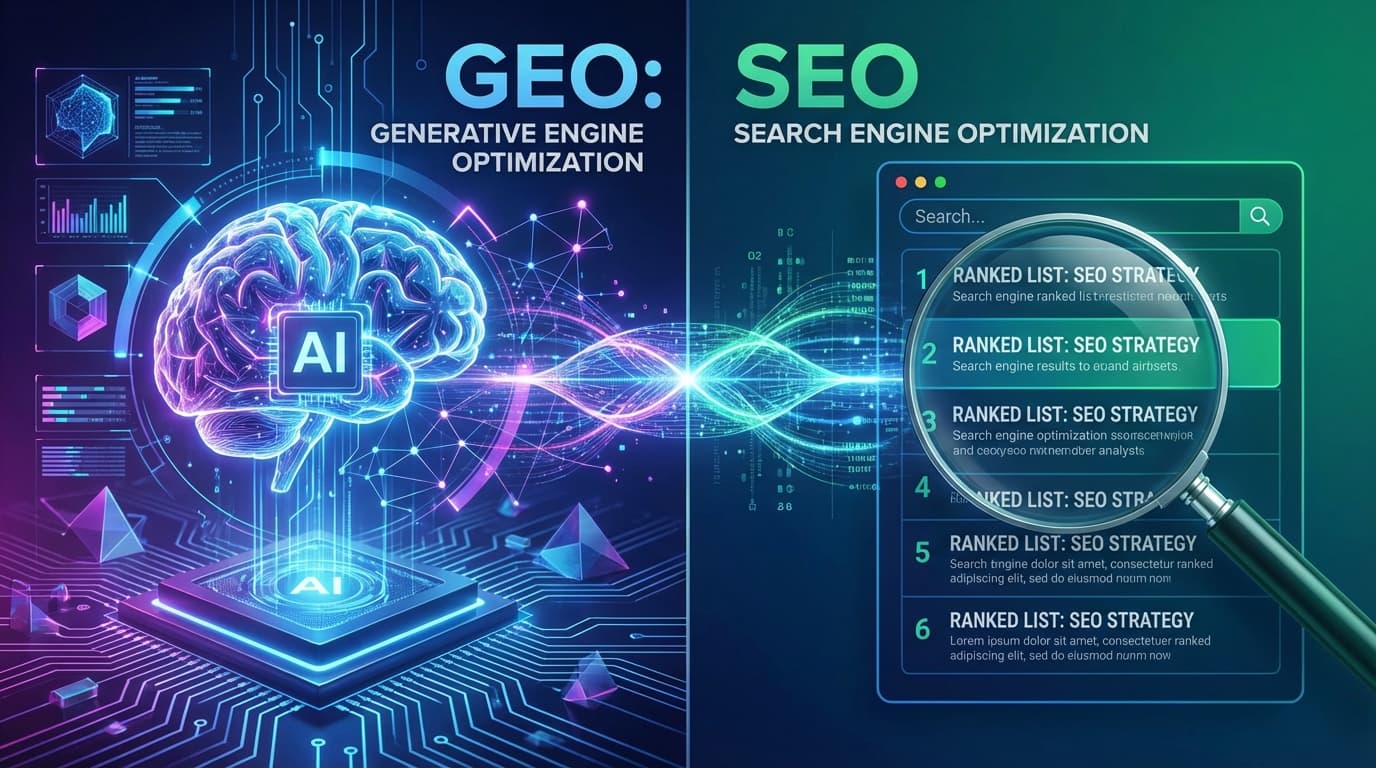
Generative Engine Optimization (GEO) is the practice of optimizing your content to be cited by AI platforms like ChatGPT, Perplexity, Claude, and Google AI Overviews. Unlike traditional SEO that aims for top 10 rankings, GEO targets being one of just 2-7 sources cited in AI responses—where 93% of AI searches end without a click to external sites.
The key difference: SEO helps you rank in a list. GEO gets you mentioned in the answer itself.
This guide explains how GEO works, why it matters in 2026, and how to start optimizing for AI citations.
What is Generative Engine Optimization (GEO)?
Generative Engine Optimization (GEO) is the strategic practice of optimizing content, brand presence, and digital footprint to maximize visibility and citations within AI-generated responses from platforms like ChatGPT, Perplexity, Claude, Google Gemini, and Microsoft Copilot.
At its core, GEO focuses on a fundamentally different outcome than traditional search optimization:
- Traditional SEO goal: Rank high in a list of search results to earn clicks
- GEO goal: Get cited within the AI-generated answer itself
When a user asks an AI platform "What's the best CRM for small businesses?" they receive a single, comprehensive response that synthesizes information from multiple sources. GEO ensures your brand is mentioned, recommended, or cited in that response.
Why GEO is Different: The Zero-Click Reality
According to recent research, around 93% of AI Mode searches end without a click. Unlike Google's traditional search results where users browse multiple options, AI platforms provide direct answers. This creates a "winner-takes-all" dynamic where being cited means everything, and being absent means invisibility.
The shift is dramatic:
- Google Search: 10+ results per page, millions of pages, users browse and compare
- AI Search: 2-7 citations per response, direct answer format, minimal external navigation
This fundamental difference requires a completely new approach to optimization-one that prioritizes citation-worthiness over click-worthiness.
The Evolution: From SEO to ASO to GEO
To understand GEO, it helps to see how search optimization has evolved over three distinct eras:
Era 1: SEO (1990s-2010s) - The Desktop Web Era
What it optimized for: Google search rankings
Key tactics:
- Keyword research and density optimization
- Backlink building
- On-page technical optimization
- Meta tags and structured data
- Page speed and mobile-friendliness
Success metric: Organic traffic and rankings
Why it worked: Google dominated search with 92%+ market share. Ranking in the top 3 results drove massive traffic.
Era 2: ASO (2008-2020s) - The Mobile App Era
What it optimized for: App store rankings (Apple App Store, Google Play)
Key tactics:
- App title and description optimization
- Keyword optimization in app metadata
- Ratings and review management
- Download velocity and retention metrics
- Screenshots and preview videos
Success metric: App installs and store rankings
Why it worked: Mobile apps became the dominant interface for many services. App store visibility determined success for mobile-first businesses.
Era 3: GEO (2023-Present) - The AI Search Era
What it optimizes for: Citations in AI-generated responses
Key tactics:
- Content structure for AI extraction
- Citation-worthy authority building
- Multi-platform presence (Wikipedia, Reddit, authoritative publications)
- Factual clarity and source credibility
- Fresh, comprehensive information
Success metric: Mention rate, citation position, and recommendation strength across AI platforms
Why it matters: ChatGPT processes over 1 billion prompts daily, with AI search platforms collectively reaching billions of users. Traditional search traffic is expected to drop by 25% by 2026 as users shift to AI-powered interfaces.
The Paradigm Shift
Each era didn't fully replace the previous one-desktop search didn't die with mobile apps, and traditional SEO remains important alongside GEO. However, each new era represented a fundamental shift in how users discover information:
- SEO Era: "I'll search Google and browse options"
- ASO Era: "I'll check the app store for solutions"
- GEO Era: "I'll ask ChatGPT for a recommendation"
The businesses that recognized and adapted to each shift early gained significant competitive advantages. We're now in the early stages of the GEO era, making this the optimal time to establish dominance in AI search visibility.
How GEO Differs from Traditional SEO
While GEO and SEO share some foundational principles-quality content, authority, and relevance-they diverge significantly in strategy, execution, and measurement.
1. Outcome Objective
SEO: Earn clicks by ranking high in search results GEO: Get cited within the AI-generated answer
Implication: SEO content is optimized for click-through rate (compelling titles, meta descriptions). GEO content is optimized for extraction and citation (factual clarity, structured data, source credibility).
2. Success Metrics
SEO Key Metrics:
- Keyword rankings (position 1-100)
- Organic traffic volume
- Click-through rate (CTR)
- Bounce rate and engagement
GEO Key Metrics:
- Mention rate (% of relevant queries where you're cited)
- Citation position (primary recommendation vs. alternative vs. passing mention)
- Recommendation strength (how strongly the AI suggests your solution)
- Engine coverage (which platforms cite you: ChatGPT, Perplexity, Claude, etc.)
Implication: You can have excellent SEO performance but zero GEO visibility, or vice versa. Research shows that 40.58% of AI citations come from Google's top 10 results, indicating overlap but not complete alignment.
3. Content Format Preferences
SEO Favors:
- Long-form content (2,000+ words)
- Keyword optimization and variations
- Internal linking structures
- Engaging headlines for clicks
GEO Favors:
- Structured, scannable content with clear sections
- Factual statements with citations
- Statistics, data, and specific details
- Direct answers to questions
- Comparison tables and bullet points
Implication: Research shows that including citations, quotations from relevant sources, and statistics can significantly boost visibility in AI search results. Content must be optimized for extraction, not just engagement.
4. Ranking Systems
SEO: Hierarchical ranking system (positions 1-10, pages 1-100) GEO: Binary citation system (mentioned or not mentioned)
Implication: In SEO, being #11 still provides some value. In GEO, if you're not in the top 2-7 citations, you effectively don't exist for that query. This creates a winner-takes-all dynamic focused on brand visibility and mentions rather than incremental ranking improvements.
5. Optimization Signals
SEO Primary Signals:
- Backlinks from authoritative domains
- On-page keyword optimization
- Technical performance (Core Web Vitals)
- User engagement metrics
- Domain authority
GEO Primary Signals:
- Citation in high-authority sources (Wikipedia, Reddit, major publications)
- Content structure and extractability
- Factual accuracy and recency
- Brand mentions across diverse sources
- Third-party validation
Implication: GEO methods focus on getting mentioned in the sources that AI platforms trust, which often means building presence beyond your own domain.
6. Topic Targeting Approach
SEO: Keyword-focused targeting with specific search terms GEO: Topic-focused targeting with broader subject coverage
Implication: One of the biggest GEO trends for 2026 is focusing on topic targeting over keyword targeting, meaning targeting broader subjects instead of specific keyword phrases.
7. Competitive Dynamics
SEO: Relative competition (outrank specific competitors) GEO: Absolute authority (establish category expertise)
Implication: In SEO, you might target low-competition keywords to gain traction. In GEO, you need sufficient authority to be citation-worthy regardless of competition level.
The Complementary Relationship
Despite these differences, the best strategy isn't choosing between them—it's integrating GEO into your SEO workflow so your brand is visible in both traditional search results and AI-generated answers. Many of the same authority and relevance signals that traditional search algorithms use also influence AI platform citations.
Traditional SEO remains essential. GEO and AEO enhance rather than replace SEO, as generative engines rely on many of the same authority and relevance signals.
The Generative Engine Landscape
Understanding the major AI search platforms helps clarify what you're optimizing for. Each platform has unique characteristics, user bases, and content preferences.
ChatGPT (OpenAI)
Market Position: Dominant player with 59.5% US market share and 79.79% globally
User Scale: Reached 800 million weekly users in March 2025, with 122.6 million daily active users
Key Features:
- ChatGPT Search enables real-time web access
- Multimodal capabilities (text, image, voice)
- Custom GPT marketplace for specialized assistants
- Enterprise and API offerings
Citation Behavior:
- 47.9% of citations come from Wikipedia
- Heavily favors high-authority domains
- Prefers comprehensive, encyclopedia-style content
- Strong bias toward established sources
Optimization Strategy: Build Wikipedia presence, earn mentions in authoritative publications, create comprehensive reference-style content.
Perplexity AI
Market Position: 6.2% US market share with around 22 million users
User Scale: Processes 30 million daily queries (up from 3,000 in 2022)
Key Features:
- Built-in web search (core differentiator)
- Source citations displayed prominently
- Follow-up question suggestions
- Mobile-app focused platform
Citation Behavior:
- 46.7% of citations come from Reddit
- Prioritizes freshness and recency
- Favors discussion-style, authentic content
- More diverse source pool than ChatGPT
Optimization Strategy: Engage authentically on Reddit, publish fresh content regularly, create comparison and discussion-oriented content.
Claude (Anthropic)
Market Position: 3.2% US consumer market share, but dominates enterprise with 32% share vs OpenAI's 25%
User Scale: Growing steadily, particularly in business contexts
Key Features:
- 200K token context window (extensive document processing)
- Strong safety and alignment focus
- Enterprise-focused positioning
- Nuanced, thoughtful responses
Citation Behavior:
- Emphasizes balanced perspectives
- Requires clear structure and logical organization
- Values credible sources and citations
- Prefers nuanced analysis over simple answers
Optimization Strategy: Provide depth and nuance in content, include credible citations, structure information clearly, offer balanced viewpoints.
Google Gemini
Market Position: Growing rapidly with 13.4% US market share, up from 5.4% a year ago to 18.2% globally
User Scale: 1.351 billion visits globally, second only to ChatGPT
Key Features:
- Deep integration with Google Search and services
- AI Overviews in search results
- Multimodal capabilities
- Leverages Google's vast data infrastructure
Citation Behavior:
- Relies heavily on traditional SEO signals
- Favors content already ranking well in Google
- Benefits from schema markup and structured data
- Prioritizes Google-indexed, high-authority sources
Optimization Strategy: Maintain strong SEO fundamentals, implement comprehensive schema markup, optimize for Google's existing ranking factors.
Microsoft Copilot
Market Position: 14% US market share
User Scale: Extensive reach through Windows 11, Edge browser, and Microsoft 365 integration
Key Features:
- Integrated into Windows, Edge, Office apps
- Powered by GPT-4 with Bing search integration
- Enterprise focus through Microsoft 365 Copilot
- Built into productivity workflows
Citation Behavior:
- Leverages Bing search results
- Favors Microsoft ecosystem content
- Business and productivity focused
- Integration-oriented recommendations
Optimization Strategy: Optimize for Bing search, create productivity and business-focused content, emphasize integration capabilities.
Platform Diversification Strategy
While ChatGPT has the largest market share, platforms like Copilot, Gemini, and Perplexity still capture significant portions of the market, and each platform is gaining users daily. A comprehensive GEO strategy addresses all major platforms rather than focusing exclusively on one.
Why GEO Matters in 2026
The case for investing in GEO isn't speculative-it's supported by clear market data, user behavior shifts, and business outcomes.
1. Massive User Adoption
The numbers are staggering:
- Over 1 billion prompts sent to ChatGPT every day
- More than 71% of Americans use AI search to research purchases or evaluate brands
- 59% of buyers use AI tools for product research before purchasing decisions
- ChatGPT receives 5.844 billion visits while Gemini gets 1.351 billion visits globally
These aren't early adopter numbers-this is mainstream behavior. AI search has crossed the chasm from innovation to standard practice.
2. Traditional Search Decline
The shift away from traditional search is accelerating:
- Reliance on search engines for internet users is expected to drop by 25% by 2026
- 1 in every 4 searches now ends without a click
- AI overviews reach over 2 billion users every month
- 527% year-over-year growth in AI search traffic (2024-2025)
This isn't a future trend-it's happening now. Every quarter, more traffic shifts from traditional search to AI-powered interfaces.
3. Higher-Intent Users
AI search attracts users at critical decision-making moments:
- 4.4x higher conversion rates from AI search visitors compared to traditional search
Users asking AI for recommendations are often further along in their buying journey, ready to evaluate specific solutions rather than just browsing options.
4. Platform Loyalty Formation
One of the biggest developments in 2026 is the formation of platform loyalty, as people become more confident about which generative engines they prefer and tend to stick with them.
This creates a "default choice" dynamic similar to how users picked Google over other search engines. Once users establish their preferred AI platform, they consistently return to it for research and recommendations.
5. Zero-Click Search Dominance
The most significant shift: around 93% of AI Mode searches end without a click.
This means:
- Users get their answers directly from the AI
- Being cited is more valuable than ranking for clicks
- Brand mentions drive awareness even without direct traffic
- Attribution becomes challenging but brand lift remains measurable
6. Competitive Timing Advantage
We're in the early stages of GEO maturity. Most brands are still asking "What is GEO?" rather than implementing strategies. This creates a significant first-mover advantage:
- Less competition for citations
- Easier to establish category authority
- Opportunity to dominate before competitors catch up
- Build citation history that compounds over time
7. Enterprise Adoption Acceleration
Gemini is growing Pro subscriptions nearly 300% YoY, compared to 155% for ChatGPT, showing strong momentum in paid user acquisition.
Claude dominates the enterprise segment with 32% market share, compared to OpenAI's 25%, indicating that business users are heavily adopting AI search for professional decisions.
This enterprise adoption means B2B brands face particularly high stakes-their buyers are using AI to evaluate vendors, compare solutions, and make purchase recommendations.
The Bottom Line
GEO matters in 2026 because it's where your customers are making decisions. Ignoring GEO means being invisible at critical discovery and evaluation moments-precisely when buyers are forming their shortlists and seeking recommendations.
Core GEO Principles
Successful GEO strategies are built on several fundamental principles that differ significantly from traditional SEO approaches.
1. Citation-Worthiness Over Click-Worthiness
The Principle: Optimize content to be extracted and cited, not just discovered and clicked.
In Practice:
- Front-load key information (answers in the first paragraph)
- Use clear, factual language that AI can confidently extract
- Structure content with scannable headings and sections
- Include specific data points, statistics, and verifiable claims
- Provide definitive statements AI platforms can cite with confidence
Example:
Click-worthy (SEO): "Discover the shocking truth about CRM pricing that vendors don't want you to know!"
Citation-worthy (GEO): "Enterprise CRM platforms average $75-150 per user per month, with implementation costs ranging from $50,000-500,000 depending on user count and customization requirements."
2. Multi-Source Authority Building
The Principle: Build presence across the diverse sources AI platforms trust, not just your own domain.
In Practice:
- Earn Wikipedia mentions (47.9% of ChatGPT citations)
- Engage authentically on Reddit (46.7% of Perplexity citations)
- Get featured in authoritative publications
- Build citation history across multiple trusted domains
- Create third-party validation beyond owned content
Why It Matters: AI platforms synthesize information from multiple sources. A single authoritative domain is less impactful than consistent mentions across diverse, trusted sources.
3. Freshness and Recency
The Principle: AI platforms strongly favor current, up-to-date information.
In Practice:
- Update key content quarterly (at minimum)
- Include current year in titles and dates
- Reference recent data and statistics
- Reflect current market conditions and trends
- Maintain publication dates and "last updated" timestamps
Example: A comparison article from 2023 will rarely be cited in 2026, even if the information remains accurate. Adding "(2026 Update)" and refreshing data dramatically increases citation probability.
4. Structured Clarity
The Principle: Make your content easy for AI to understand, extract, and synthesize.
In Practice:
- Use descriptive headings (H2, H3) that identify topics clearly
- Create comparison tables for multi-option scenarios
- Format key points as bullet lists
- Include clear definitions and explanations
- Add schema markup for structured data
- Use consistent formatting patterns
Bad Structure:
Our product offers amazing features that will transform your business.
We have everything you need in one platform.
Good Structure:
## Key Features

- **Team Collaboration**: Real-time editing with 50+ simultaneous users
- **Project Tracking**: Kanban, Gantt, and calendar views
- **Integrations**: 150+ native integrations including Slack, Google Workspace, Salesforce
- **Pricing**: $12/user/month for teams of 10-50 users
5. Factual Objectivity
The Principle: AI platforms filter out overly promotional or biased content.
In Practice:
- Acknowledge competitor strengths honestly
- Present balanced comparisons
- Admit your product's limitations
- Use neutral language even when discussing your solution
- Support claims with data and sources
Why It Matters: When creating comparison content, being genuinely objective increases trust and citation likelihood. AI platforms can detect one-sided promotional content and often exclude it.
6. Comprehensive Topic Coverage
The Principle: Focus on topic targeting over keyword targeting, addressing broader subjects comprehensively.
In Practice:
- Cover topics in depth, not just specific keywords
- Address related questions and subtopics
- Provide context and background
- Include various perspectives and use cases
- Answer the "why" and "how" not just the "what"
Example: Instead of optimizing for the keyword "project management software pricing," create comprehensive content covering "Complete Guide to Project Management Software: Features, Pricing, Use Cases, and Selection Criteria."
7. Verifiable Specificity
The Principle: Specific, verifiable facts are more citation-worthy than general statements.
In Practice:
General: "Our platform is affordable for small businesses." Specific: "Plans start at $29/month for teams of up to 10 users."
General: "We have many satisfied customers." Specific: "Over 12,000 companies use our platform, with an average rating of 4.7/5 based on 3,200+ reviews."
General: "We integrate with popular tools." Specific: "Native integrations with Slack, Microsoft Teams, Salesforce, HubSpot, Google Workspace, and 145+ other platforms."
8. Source Credibility and Citations
The Principle: AI platforms prioritize content that cites credible sources.
In Practice:
- Include citations to authoritative sources
- Reference studies, research, and data
- Link to original sources and primary research
- Use quotations from experts and thought leaders
- Provide transparent methodology for any claims
Why It Matters: Research shows that including citations, quotations from relevant sources, and statistics significantly boosts website visibility in AI search results.
Getting Started with GEO
If you're new to GEO, here's a practical roadmap for your first 30-60 days.
Phase 1: Foundation (Week 1-2)
1. Technical Audit and Optimization
Check your /robots.txt file to ensure you're allowing AI crawlers:
# Allow all major AI crawlers
User-agent: GPTBot
Allow: /

User-agent: ClaudeBot
Allow: /

User-agent: PerplexityBot
Allow: /

User-agent: Google-Extended
Allow: /

User-agent: CCBot
Allow: /
Performance Check:
- Run PageSpeed Insights on key pages
- Ensure Time to First Byte < 200ms
- Verify Largest Contentful Paint < 2.5s
- Test on actual AI crawlers if possible
Schema Markup: Implement basic structured data for your organization, products, and key pages:
{
  "@context": "https://schema.org",
  "@type": "Organization",
  "name": "Your Company",
  "description": "Clear, one-sentence description of what you do",
  "url": "https://yourcompany.com",
  "logo": "https://yourcompany.com/logo.png",
  "foundingDate": "2020",
  "industry": "Software"
}
2. Baseline Assessment
Create a list of 20-30 target queries where you want to be cited:
- "Best [your category] for [use case]"
- "What is [your category]"
- "[Competitor] alternatives"
- "How to [solve problem your product addresses]"
- "[Your category] comparison"
Test each query across:
- ChatGPT
- Perplexity
- Claude
- Google AI Overviews
Document:
- Are you mentioned? (Yes/No)
- Position (Primary recommendation, Alternative, Passing mention)
- How you're described
- Who else is cited
This baseline helps you track progress and identify gaps.
Phase 2: Quick Wins (Week 3-4)
1. Update Existing High-Performing Content
Find content that already ranks well in Google but isn't being cited by AI:
- Add current year to title: "Guide to [Topic] (2026 Update)"
- Add statistics and specific data points
- Create comparison tables where relevant
- Front-load key information
- Add clear, scannable structure
- Include source citations
2. Create Your First Comparison Article
Choose your top competitor and create a detailed, objective comparison:
# [Your Product] vs [Top Competitor]: Detailed Comparison (2026)

## Quick Summary

| Feature | Your Product | Competitor |
|---------|--------------|------------|
| Pricing | $29/user/month | $49/user/month |
| [Key Feature 1] | Yes | Yes |
| [Key Feature 2] | Advanced | Basic |
| [Key Feature 3] | No | Yes |
| Best For | [Specific use case] | [Different use case] |

## Detailed Comparison

### Pricing
[Specific pricing details for both, including tiers, discounts, enterprise options]

### [Feature Category]
**Your Product**: [Honest assessment]
**Competitor**: [Fair acknowledgment of their strengths]
**Winner**: [Honest determination based on use case]

### When to Choose [Your Product]
- Specific scenario 1
- Specific scenario 2

### When to Choose [Competitor]
- Honest scenario where they're better
- Another scenario where they win
3. Identify Wikipedia Opportunities
Search Wikipedia for:
- Your product category (e.g., "Project management software")
- Comparison pages (e.g., "Comparison of project management software")
- Industry or technology pages where your solution is relevant
Note which pages exist and whether you could be legitimately added (requires third-party sources).
Phase 3: Authority Building (Month 2)
1. Reddit Engagement Strategy
Identify 5-10 relevant subreddits:
- Category-specific communities
- Target customer communities
- General business/tech communities
Engagement approach:
- Join communities authentically
- Provide value without promoting
- Answer questions genuinely
- Share expertise generously
- Mention your product only when directly relevant
- Always disclose your affiliation
Example comment template:
"I've used [Competitor A], [Competitor B], and several others. Here's what I learned:

[Competitor A]: Best for [specific use case]. Pros: [genuine strengths]. Cons: [honest limitations].

[Competitor B]: Great for [different use case]. The [feature] is excellent, but [honest drawback].

Disclosure: I work on [Your Product], which focuses specifically on [differentiated positioning]. But honestly, if you're [scenario], [Competitor] is probably your best bet. If you're [your sweet spot], we'd be a great fit. Happy to answer questions about any of these."
2. Original Research or Data
Plan and execute one original data initiative:
Option A - Customer Survey:
- Survey your users about industry trends, challenges, ROI
- "State of [Your Industry] 2026: Data from 500+ Companies"
- Publish findings with charts and insights
Option B - Competitive Analysis:
- Test and compare actual products in your category
- "We Tested 10 [Category] Tools - Here's What We Found"
- Include methodology, data, and honest conclusions
Option C - Industry Benchmark:
- Compile industry data, pricing, features, adoption trends
- "[Category] Benchmark Report 2026: Pricing, Features, and Market Analysis"
- Create comprehensive reference resource
3. Build Third-Party Mentions
Priority activities:
- Guest post on industry publications
- Get featured in software review sites (G2, Capterra, etc.)
- Participate in industry roundups and expert surveys
- Seek coverage in relevant newsletters and media
- Contribute to industry reports and research
These third-party mentions create the citation network AI platforms trust.
Phase 4: Measurement and Iteration (Ongoing)
Monthly Testing Protocol:
- Test your 20-30 target queries across all platforms
- Document changes (new citations, position improvements, losses)
- Identify patterns (which content types get cited, which platforms favor you)
- Adjust strategy based on results
Track These Metrics:
- Mention Rate: What % of target queries cite you
- Position Quality: Primary vs alternative vs passing mention
- Engine Coverage: Which platforms cite you
- Citation Context: How you're described and positioned
- Business Impact: Brand search volume, referral traffic, conversions
Tools to Consider:
- Citedify: Automated tracking across ChatGPT, Perplexity, Claude, Google AI
- Manual Testing: Regular spot-checks across platforms
- Google Analytics: Track traffic from AI platforms
- Brand Monitoring: Track mention volume and sentiment
First 60 Days Checklist
- Audit and fix robots.txt to allow AI crawlers
- Implement basic schema markup
- Test performance and optimize for < 2.5s LCP
- Create baseline assessment (20-30 queries across 4 platforms)
- Update 3-5 high-performing pages with GEO optimization
- Publish first detailed comparison article
- Publish first "[Competitor] Alternatives" article
- Join 5 relevant subreddit communities
- Make 20+ authentic Reddit contributions
- Identify Wikipedia pages for potential inclusion
- Plan original research/data initiative
- Pitch 3 guest post opportunities
- Complete month 1 testing cycle
- Document what's working and what's not
- Adjust strategy based on results
GEO Success Metrics: How to Measure Results
Unlike SEO's well-established metrics (rankings, traffic, conversions), GEO requires new measurement frameworks.
Primary Metrics
1. Mention Rate
Definition: The percentage of target queries where your brand is cited
Calculation: (Queries where you're mentioned) / (Total target queries) × 100
Example: If you're cited in 15 out of 50 target queries, your mention rate is 30%
Benchmark:
- 0-10%: Early stage, significant work needed
- 10-30%: Emerging presence, building momentum
- 30-50%: Strong visibility in your category
- 50%+: Category leader, dominant presence
2. Citation Position
Definition: How prominently you're featured in AI responses
Categories:
- Primary Recommendation: Named as the top or primary solution
- Alternative Option: Listed as one of several good options
- Passing Mention: Referenced but not recommended
- Not Mentioned: Absent from the response
Tracking: Document position for each query and calculate distribution
Example Analysis:
- Primary: 8 queries (16%)
- Alternative: 22 queries (44%)
- Passing: 10 queries (20%)
- Not mentioned: 10 queries (20%)
3. Engine Coverage
Definition: Which AI platforms cite you across your target queries
Track:
- ChatGPT citation rate
- Perplexity citation rate
- Claude citation rate
- Google AI Overviews citation rate
- Copilot citation rate
Why It Matters: Platform diversification reduces dependency risk and maximizes total addressable audience.
4. Recommendation Strength
Definition: How strongly the AI recommends your solution
Qualitative Scale:
- Strong: "X is the best choice for..." or "We recommend X because..."
- Moderate: "X is a good option" or "Consider X"
- Weak: "X is also available" or "Another option is X"
Tracking: Document actual language used in citations to identify improvement opportunities
Secondary Metrics
5. Brand Search Volume
Track branded search queries in Google Analytics and Google Search Console:
- Month-over-month growth in brand searches
- New vs returning branded search traffic
- Geographic distribution of brand searches
Why It Matters: AI citations drive brand awareness even without direct clicks. Users who learn about you from ChatGPT may subsequently search for your brand directly.
6. Direct and Referral Traffic
Some AI platforms do provide clickable citations:
- Track referral traffic from ai.google.com, perplexity.ai
- Monitor direct traffic increases (often driven by AI awareness)
- Analyze conversion rates of AI-referred traffic
7. Citation Context Quality
Evaluate how you're described in citations:
- Are key differentiators mentioned?
- Is positioning accurate?
- Are strengths highlighted?
- Is the use case description aligned with your ICP?
8. Competitive Citation Share
Definition: What percentage of category citations you capture vs competitors
Calculation: Your mentions / Total category mentions (you + competitors)
Example: If your brand is cited 25 times and competitors are cited 75 times across the same queries, your citation share is 25%.
Business Impact Metrics
9. Pipeline Influence
Track deals where prospects mention discovering you through AI search:
- Add source tracking in your CRM
- Include "How did you hear about us?" in forms
- Ask during sales calls about discovery path
10. Conversion Rate by Source
Compare conversion rates:
- AI search referral traffic
- Traditional search traffic
- Direct traffic
- Other sources
Early data suggests 4.4x higher conversion rates from AI search traffic, but measure your specific performance.
Measurement Framework
Monthly Reporting Template:
# GEO Performance Report - [Month Year]

## Core Metrics
- Mention Rate: X% (vs Y% last month)
- Total Queries Tested: X
- Citations Gained: +X
- Citations Lost: -X

## Platform Breakdown
| Platform | Mention Rate | Change |
|----------|--------------|--------|
| ChatGPT | X% | ↑ Y% |
| Perplexity | X% | → |
| Claude | X% | ↓ Y% |
| Google AI | X% | ↑ Y% |

## Citation Position Distribution
- Primary Recommendations: X (Y%)
- Alternative Options: X (Y%)
- Passing Mentions: X (Y%)

## Business Impact
- Brand Search Volume: X (↑ Y% MoM)
- AI Referral Traffic: X visits
- Conversion Rate: X%

## Insights & Actions
- What's working: [Observations]
- What needs improvement: [Gaps]
- Next month priorities: [Actions]
Tools and Platforms
Automated Monitoring:
- Citedify: Track citations across ChatGPT, Perplexity, Claude, Google AI
- Otterly.AI: AI search visibility monitoring
- Custom scripts using AI platform APIs
Manual Tracking:
- Spreadsheet with target queries, test dates, and results
- Screenshot documentation of citations
- Monthly testing protocol with standardized queries
Analytics:
- Google Analytics 4 for traffic and conversions
- Google Search Console for brand search trends
- CRM source tracking for pipeline influence
Setting Realistic Expectations
Timeline:
- Month 1-2: Foundation building, limited visible results
- Month 3-4: First citations appear for easier queries
- Month 6-9: Meaningful mention rate improvement (10-20%)
- Month 12+: Strong category presence (30%+ mention rate for leaders)
Investment:
- Small teams: 10-15 hours/week minimum
- Dedicated resource: 1 FTE focusing on GEO strategy
- Agency/consultant: $3,000-10,000/month for professional execution
ROI Considerations: GEO is a long-term investment similar to traditional SEO. Early movers gain compounding advantages as citation history builds and authority establishes.
Frequently Asked Questions
Is GEO replacing SEO?
No, GEO doesn't replace SEO—it builds on it. 40.58% of AI citations come from Google's top 10 results, meaning strong SEO fundamentals remain essential. Think of GEO as an additional optimization layer that ensures your content gets cited in AI-generated answers, not just ranked in traditional search results.
How long does GEO take to show results?
Expect to see initial citations within 6-8 weeks of consistent optimization efforts. Meaningful mention rates (20%+ of target queries) typically develop over 4-6 months. GEO works like compound interest—early movers build citation authority that reinforces over time.
Which AI platforms should I prioritize for GEO?
Start with ChatGPT (79.79% global market share), then expand to Perplexity, Google AI Overviews, and Claude. Each platform has different preferences—ChatGPT favors Wikipedia citations, Perplexity leans heavily on Reddit, and Google AI Overviews correlate strongly with traditional SEO rankings. A comprehensive GEO strategy addresses all major platforms.
How do I measure GEO success?
Track four key metrics: mention rate (percentage of queries where you're cited), citation position (primary recommendation vs. alternative), engine coverage (which platforms cite you), and recommendation strength (how strongly AI suggests your solution). Tools like Citedify automate this tracking across platforms.
What's the difference between GEO and AEO (Answer Engine Optimization)?
GEO and AEO are often used interchangeably. Both focus on optimizing content to appear in AI-generated answers. Some practitioners use "AEO" specifically for voice search and featured snippets, while "GEO" emphasizes AI platforms like ChatGPT and Claude. The optimization principles largely overlap.
Do I need technical changes to my website for GEO?
Yes, technical foundations matter. Ensure your robots.txt allows AI crawlers (GPTBot, ClaudeBot, PerplexityBot), optimize for sub-500ms response times, implement structured data (schema markup), and use server-side rendering if your site relies on JavaScript. AI crawlers don't execute JavaScript and have tight timeout windows.
Conclusion: The GEO Imperative
Generative Engine Optimization represents a fundamental shift in how brands achieve digital visibility. With over 1 billion daily prompts to ChatGPT, 71% of Americans using AI search for purchase research, and traditional search expected to decline 25% by 2026, the question isn't whether to invest in GEO-it's how quickly you can establish presence before competitors dominate your category.
The brands that master GEO now, while most competitors are still asking "What is GEO?", will build citation authority that compounds over time. They'll capture mindshare at critical discovery moments, influence purchase decisions before prospects ever visit their website, and establish category leadership in the AI search era.
Your first step is simple: test 20 queries across ChatGPT, Perplexity, and Claude. Document where you're mentioned and where you're invisible. That baseline reveals your opportunity.
Ready to see where you stand? Get your AI Visibility Audit — $499 one-time report with your score, competitor comparison, and 90-day action plan.