How to create content AI engines cite: use answer-first architecture (lead with the direct answer), write shorter paragraphs (2-3 sentences max), structure with question-focused headings, include data and statistics (40% higher citation rate), add FAQ sections with schema, and maintain freshness (update every 30-90 days).
AI engines cite only 2-7 sources per query. Traditional SEO content optimized for comprehensiveness often fails because AI needs extractable clarity—clear answers in modular sections.
This guide covers the GEO content framework with templates and examples you can implement this week.
Why GEO Content Is Different From SEO Content
SEO and GEO require fundamentally different content approaches. Understanding these differences is critical before you write a single word.
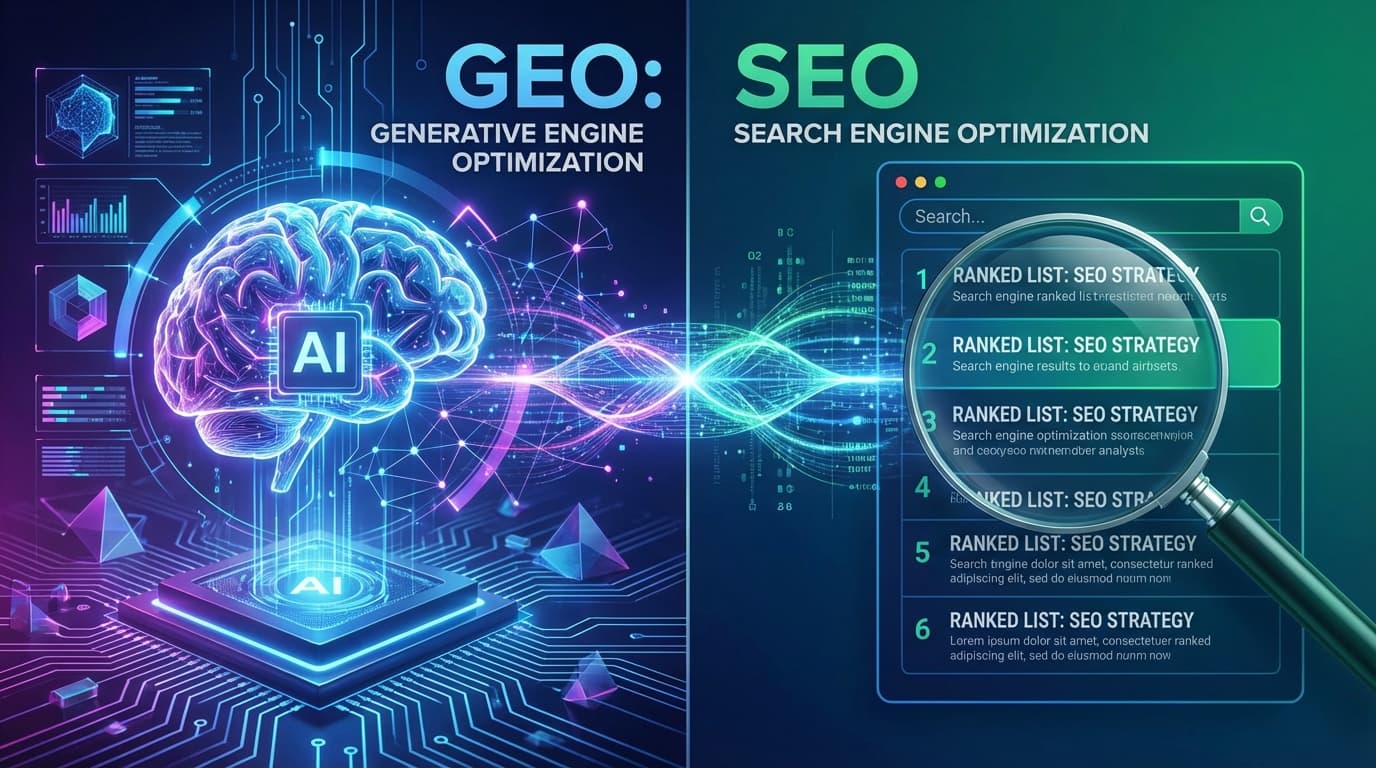
The Core Shift: Ranking vs Citation
SEO Content is built to rank in search results. You optimize for keywords, build backlinks, improve page speed, and aim for positions 1-10 on the SERP.
GEO Content is built to be cited in AI-generated responses. You optimize for extraction, structure for comprehension, and aim to be one of 2-7 sources the AI engine references.
This distinction changes everything about how you create content.
How AI Engines Process Content Differently
Traditional search engines use algorithms to match queries with relevant pages based on keywords, backlinks, and hundreds of other ranking factors.
AI engines use large language models to understand the query's intent, retrieve relevant information from their training data and real-time sources, synthesize an answer, and cite sources that contributed to that answer.
The implications for content strategy:
SEO focuses on comprehensive coverage. More words, more sections, more keywords. The goal is to be the most complete resource on the topic.
GEO focuses on extractable clarity. Clear answers, modular sections, structured formatting. The goal is to make it effortless for AI to extract and cite your insights.
Content Structure Comparison
| Element | SEO Content | GEO Content |
|---|---|---|
| Length | Longer is better (2,500-5,000 words) | Depth matters, but clarity matters more (2,000-3,500 words) |
| Paragraphs | 3-5 sentences typical | 2-3 sentences maximum |
| Headings | Keyword-focused | Question-focused and conversational |
| Formatting | Important but secondary | Critical for extraction |
| Citations | Outbound links improve SEO | Essential trust signals for AI |
| Data | Nice to have | 40% higher citation rate |
| Freshness | Important for some niches | Critical-76.4% of cited content updated in last 30 days |
The Answer-First Paradigm
The biggest structural difference: GEO content must be answer-first.
Traditional SEO content often buries the answer after context, storytelling, or setup. This works for humans reading sequentially but fails for AI engines extracting information.
SEO approach:
Understanding Project Management Tools: A Complete Guide

Project management has evolved dramatically over the past decade.
Remote work, distributed teams, and agile methodologies have
transformed how teams collaborate. In this comprehensive guide,
we'll explore the landscape of modern project management tools,
examining their features, use cases, and value propositions...

[Answer appears 400 words in]
GEO approach:
What Are the Best Project Management Tools for Remote Teams in 2026?

The best project management tools for remote teams in 2026 are:
1. Asana - Best for workflow automation and timeline views
2. Monday.com - Best for visual project tracking
3. ClickUp - Best for all-in-one functionality
4. Linear - Best for software development teams

[Each option then gets 150-200 word detailed explanation]
[Context and methodology follow]
The GEO version makes it effortless for an AI engine to extract the answer, understand the context, and cite your content confidently.
Content Formats That Dominate AI Citations
Not all content formats perform equally in AI citations. Based on analysis of 8,000+ AI citations, certain formats dramatically outperform others.
1. Comparison Content (Highest Citation Rate)
Comparison content is citation gold. Why? Because users naturally ask comparative questions, and the format is perfectly structured for AI extraction.
High-performing comparison formats:
Head-to-Head Comparisons
"Product A vs Product B: Which Is Better for [Use Case]?"

Quick Comparison Table:
| Feature | Product A | Product B |
|---------|-----------|-----------|
[5-8 key differences]

Detailed Analysis:
[Section for each major feature/consideration]

Recommendation:
Choose Product A if [specific conditions]
Choose Product B if [specific conditions]
Alternative Pages
"10 [Competitor] Alternatives: Better Options for [Use Case]"

Each alternative gets:
- What it is (1 sentence)
- Best for (1 sentence)
- Key features (3-5 bullets)
- Pricing starting point
- Notable limitation
Category Roundups
"15 Best [Category] Tools for [Specific Use Case] (2026)"

Ranking criteria explained upfront
Each tool: 100-150 words
Comparative table
FAQ section
Real example - Before vs After:
Before (SEO-focused):
Best CRM Software: The Ultimate Guide

Customer relationship management is critical for business growth.
In this guide, we'll explore what makes a great CRM, key features
to consider, pricing models, and our top recommendations...

[Recommendation appears on page 3]
After (GEO-optimized):
15 Best CRM Platforms for Small Businesses (2026 Comparison)

## Quick Recommendations

- **Best Overall**: HubSpot CRM (Free tier available)
- **Best for E-commerce**: Salesforce ($25/user)
- **Best for Simplicity**: Pipedrive ($14/user)
- **Best for Budget**: Zoho CRM ($14/user)

## Detailed Comparison

| CRM | Starting Price | Best For | Key Feature |
|-----|----------------|----------|-------------|
[Table comparing 8-10 options]

## Individual Reviews

### 1. HubSpot CRM
HubSpot CRM offers the most generous free tier in the industry,
making it ideal for small businesses just starting with CRM.
Unlike competitors that limit free users to basic contact
management, HubSpot includes email tracking, meeting scheduling,
and pipeline management at no cost.

**Pros**:
- Unlimited free users and contacts
- Integrated with HubSpot's marketing tools
- Intuitive interface with minimal learning curve

**Cons**:
- Advanced features require paid tiers
- Can get expensive at scale
- Some users report slower performance with large databases

**Best for**: Small businesses (1-50 employees) wanting robust
free CRM with upgrade path.

**Pricing**: Free; paid tiers start at $45/month

[Continue for each option...]
The GEO version provides immediate value, structured extraction points, and comparative data that AI engines can confidently cite.
2. Data-Driven Content (40% Higher Citation Rate)
Original research and data-driven content gets cited 40% more than opinion-based content. AI engines heavily favor quantitative claims over qualitative statements.
High-performing data formats:
Benchmark Reports
"State of [Industry/Category] 2026: Data from 1,000+ Companies"

Methodology (upfront):
- Sample size
- Data collection period
- Participant demographics

Key Findings (with specific numbers):
- 73% of companies report [specific finding]
- Average investment: $X per [unit]
- Top challenge: [finding] (cited by 64% of respondents)

Supporting Charts:
[Visual data representation]

Detailed Analysis:
[Each finding explored in 150-200 words]
Comparative Studies
"We Tested 15 [Tools] - Here's What We Found"

Test Methodology:
- Specific tests conducted
- Evaluation criteria
- Time period
- Version numbers

Results Summary:
[Table with quantitative results]

Winner in Each Category:
- Performance: [Tool] - 47ms average response time
- Usability: [Tool] - 8.9/10 user rating
- Value: [Tool] - $0.08 per transaction
Industry Statistics Pages
"[Industry] Statistics: 50+ Data Points Every Marketer Should Know (2026)"

Quick Stats:
- Market size: $X billion
- Growth rate: X% CAGR
- Top trend: [Specific metric]

Categorized Statistics:
## Market Size & Growth
[5-8 stats with sources]

## User Behavior
[5-8 stats with sources]

## Technology Adoption
[5-8 stats with sources]

[Each stat includes source and date]
Critical requirement: Every data point must include a credible source citation. AI engines validate claims before citing them.
3. How-To Guides and Tutorials
For non-YMYL (Your Money Your Life) topics, how-to guides are the most commonly cited format. But the structure matters enormously.
GEO-optimized how-to structure:
How to [Accomplish Specific Goal]: Step-by-Step Guide (2026)

## What You'll Need
- Requirement 1
- Requirement 2
- Time required: X minutes

## Quick Overview
[3-5 sentence summary of the complete process]

## Step-by-Step Instructions

### Step 1: [Specific Action]
[50-100 words explaining this step clearly]

**Why this matters**: [Brief context]

**Common mistakes**: [What to avoid]

### Step 2: [Specific Action]
[Continue pattern...]

## Troubleshooting
**Problem**: [Common issue]
**Solution**: [Specific fix]

## FAQ
**Q: [Specific question]**
**A**: [Direct answer in 2-3 sentences]
Key GEO principles for guides:
- Action-oriented headings: "Configure your settings" not "Settings configuration"
- Numbered steps: AI engines extract ordered lists more accurately
- Standalone sections: Each step should make sense even when extracted alone
- Visual cues: Use bold, bullets, and formatting to highlight key actions
- Expected outcomes: State what success looks like after each major step
4. FAQ Content (Direct Answer Format)
FAQ content aligns perfectly with conversational AI queries. When structured correctly, FAQs become citation magnets.
GEO-optimized FAQ structure:
[Topic]: 25 Questions Answered by Experts

## General Questions

### What is [Term/Concept]?
[Term/Concept] is [1-sentence definition]. Unlike [common misconception],
it actually [accurate explanation in 2-3 sentences].

Example: [Real-world example in 1 sentence]

**Key takeaway**: [One sentence summary]

### How does [Process] work?
[Process] works through [brief explanation]:

1. [Step 1 in 1 sentence]
2. [Step 2 in 1 sentence]
3. [Step 3 in 1 sentence]

This typically takes [timeframe] and requires [basic requirements].

[Continue for each question...]
FAQ Schema Markup (critical for GEO):
{
  "@context": "https://schema.org",
  "@type": "FAQPage",
  "mainEntity": [{
    "@type": "Question",
    "name": "What is generative engine optimization?",
    "acceptedAnswer": {
      "@type": "Answer",
      "text": "Generative engine optimization (GEO) is the practice of optimizing content to be discovered, understood, and cited by AI-powered search engines like ChatGPT, Perplexity, and Claude. Unlike traditional SEO which focuses on ranking in search results, GEO focuses on being selected as a cited source in AI-generated responses."
    }
  }]
}
FAQ schema is particularly powerful for AI search because it provides direct question-answer pairs that AI systems can easily extract and cite.
5. Case Studies and Real Examples
Case studies perform well when structured for extraction and when they include quantifiable results.
GEO-optimized case study structure:
How [Company] Achieved [Specific Result] in [Timeframe]

## Challenge
[Company], a [description], faced [specific problem]. Traditional
solutions like [approach] resulted in [outcome]. They needed
[specific requirement].

## Solution
They implemented [specific solution] with these key components:
- Component 1: [Brief description]
- Component 2: [Brief description]
- Component 3: [Brief description]

Implementation took [timeframe] and required [resources].

## Results
After [timeframe], [Company] achieved:
- **Metric 1**: X% improvement
- **Metric 2**: $X increase
- **Metric 3**: X reduction

Total ROI: [Specific calculation]

## Key Lessons
1. [Lesson 1 in 1 sentence]
2. [Lesson 2 in 1 sentence]
3. [Lesson 3 in 1 sentence]

## Methodology
[How results were measured and validated]
The quantifiable results section is what earns citations. Vague claims like "significant improvement" won't get cited-"34% increase in conversion rate" will.
Structuring Content for AI Comprehension
AI engines don't read content the way humans do. They extract, parse, and synthesize. Your content structure must accommodate this process.
The Modular Content Framework
Think of your content as LEGO blocks, not a continuous narrative. Each section should:
- Stand alone: Make sense when extracted without surrounding context
- Answer one question: Focus on a single concept or claim
- Be 75-300 words: Short enough for AI to process as a unit
- Include context signals: Brief orientation even in subsections
Poor structure (narrative flow):
As we discussed earlier, the implementation process builds on these
foundations. Taking that framework into account, the next phase
involves several interconnected steps that work together...
Good structure (modular):
### Implementation Phase: 5 Core Steps

Implementing [solution] requires five core steps, completed
sequentially over 4-6 weeks:

1. **Initial Setup** (Week 1): Configure base settings...
2. **Data Migration** (Week 2): Transfer existing data...
[Continue...]
Each section provides complete context-no forward or backward references required.
The Hierarchy of Clarity
AI engines parse content hierarchically. Your heading structure must create a clear information architecture.
Optimal heading hierarchy for GEO:
# Page Title: Specific Topic (H1)
- Include primary keyword
- State clear benefit or outcome
- One H1 per page

## Major Sections (H2)
- Question-focused when possible
- 150-200 words of content between each H2
- Maximum 8-10 H2s per article

### Subsections (H3)
- Break down H2 topics
- 75-150 words per H3 section
- Use for lists, examples, or detailed points

#### Minor Points (H4)
- Use sparingly
- Only when H3 needs subdivision
- Avoid deeper than H4
Example hierarchy:
# How to Improve Email Deliverability: Complete Guide (2026)

## What Is Email Deliverability?
[150-200 words defining the concept]

### How Deliverability Differs From Delivery
[100 words clarifying distinction]

## 7 Factors That Impact Deliverability
[Brief intro to the list]

### 1. Sender Reputation
[150 words on this factor]

#### Monitoring Your Sender Score
[100 words on measurement]

### 2. Authentication Protocols
[150 words on SPF, DKIM, DMARC]

[Continue pattern...]
Formatting for Extraction
AI engines extract content more accurately when it uses clear, consistent formatting.
High-extraction formats:
Tables for Comparisons
| Feature | Option A | Option B | Option C |
|---------|----------|----------|----------|
| Price | $29/mo | $49/mo | $99/mo |
| Users | 10 | 25 | Unlimited |
| Storage | 100GB | 500GB | 1TB |
Bulleted Lists for Features/Benefits
Key benefits of [solution]:
- **Benefit 1**: Specific outcome or value
- **Benefit 2**: Specific outcome or value
- **Benefit 3**: Specific outcome or value
Numbered Lists for Processes/Steps
Implementation process:
1. **Step name**: Brief description of action
2. **Step name**: Brief description of action
3. **Step name**: Brief description of action
Bold for Key Terms and Numbers
The average conversion rate increased from 2.3% to **4.7%** after
implementation, representing a **104% improvement** over baseline.
Callout Boxes for Critical Information
**Important**: [Critical point that shouldn't be missed]

**Pro Tip**: [Insider advice or optimization]

**Common Mistake**: [What to avoid and why]
Paragraph Length and Density
GEO content should be scannable by both humans and AI extraction algorithms.
Optimal paragraph specifications:
- Length: 2-3 sentences maximum (40-75 words)
- Focus: One idea per paragraph
- Structure: Topic sentence + supporting detail + context/implication
- Spacing: Visual white space between paragraphs
Before (SEO-optimized):
Content marketing has evolved significantly in recent years,
particularly with the rise of AI-powered search engines and
generative AI tools that are changing how users discover information.
This evolution means that traditional content strategies focused
solely on keyword optimization and backlink building are no longer
sufficient. Modern content must be structured for both human
readers and AI comprehension, balancing the need for engaging
storytelling with the technical requirements of machine extraction.
Furthermore, the pace of change in this space means that content
creators must constantly adapt their approaches...
After (GEO-optimized):
Content marketing has fundamentally changed with the rise of AI
search engines. Traditional SEO strategies no longer guarantee
visibility in AI-generated responses.

Modern content must serve two audiences: human readers and AI
extraction systems. This requires balancing engaging narratives
with structured, extractable formatting.

The pace of change demands constant adaptation. Content strategies
that worked in 2024 may fail to earn AI citations in 2026.
The GEO version delivers the same information in shorter, more digestible units that AI engines can parse and extract more accurately.
Authority Signals and Citations
AI engines heavily weight authority and credibility when selecting sources to cite. Building strong authority signals into your content is non-negotiable for GEO success.
E-E-A-T for AI Engines
Google's E-E-A-T framework (Experience, Expertise, Authoritativeness, Trustworthiness) matters even more for GEO than SEO.
Experience: Demonstrate firsthand knowledge
We tested 15 project management tools over 90 days with our remote
team of 47 people across 6 time zones. This analysis is based on
real usage data, not demo accounts.
Expertise: Establish subject matter authority
By John Smith, PMP-certified project manager with 12 years leading
distributed teams. Previously: Director of Operations at [Company].
Authoritativeness: Reference and be referenced by credible sources
Our methodology builds on research from Stanford's Human-Computer
Interaction Lab [1] and mirrors approaches used by organizations
like [Authority] [2].

[1] Stanford HCI Lab (2025). "Remote Team Productivity Study"
[2] Authority Org (2025). "Project Management Best Practices"
Trustworthiness: Be accurate, cite sources, acknowledge limitations
Important: This analysis reflects our team's specific use case
(product development workflow). Results may differ for creative
agencies or consulting firms.

All pricing current as of January 2026. Features subject to change.
Citation Best Practices
Every factual claim, statistic, or data point should include a source. This serves two purposes:
- Builds trust with AI engines evaluating content credibility
- Enables validation when AI systems fact-check claims
Optimal citation format:
Inline Citations
According to Gartner, 73% of organizations will adopt AI-powered
search by 2026 [1]. This represents 527% growth year-over-year [2].

[1] Gartner Research (2025). "AI Search Adoption Forecast"
[2] SearchEngineLand (2025). "AI Search Growth Analysis"
Link to Original Sources
Research from Princeton's Web Transparency Project
found that AI engines cite Wikipedia in 47.9% of responses.
Data Tables with Sources
| Platform | Citation Rate | Source |
|----------|---------------|--------|
| Wikipedia | 47.9% | [Princeton Study, 2025] |
| Reddit | 46.7% | [SearchEngineLand, 2025] |
| News sites | 31.2% | [Onely Analysis, 2025] |
Building Third-Party Authority
AI engines favor content mentioned or cited by high-authority domains. Build this through:
Guest Publishing Strategy
Target publications by authority score:
- Tier 1: Industry-leading publications (DR 80+)
- Tier 2: Niche-specific sites (DR 60-80)
- Tier 3: Emerging platforms with engaged audiences (DR 40-60)

Monthly target: 2 Tier 1, 4 Tier 2, 6 Tier 3 mentions
Wikipedia Presence
Contribute to category pages:
1. Identify relevant Wikipedia pages in your category
2. Build 3-5 independent, credible source mentions
3. Add your brand to comparison tables (with citations)
4. Update quarterly with new data or features
Academic and Research Citations
Partner with research institutions:
- Provide data for academic studies
- Sponsor research aligned with your expertise
- Publish findings in peer-reviewed journals
- Make datasets publicly available
Schema Markup and Structured Data for GEO
Schema markup is critically important for AI search optimization. It tells AI systems exactly what your content means, not just what it says.
Priority Schema Types for GEO
1. Organization Schema (Foundation)
{
  "@context": "https://schema.org",
  "@type": "Organization",
  "name": "Your Company",
  "url": "https://yourcompany.com",
  "logo": "https://yourcompany.com/logo.png",
  "description": "Clear, specific description of what you do",
  "foundingDate": "2020-01-15",
  "sameAs": [
    "https://twitter.com/yourcompany",
    "https://linkedin.com/company/yourcompany"
  ],
  "contactPoint": {
    "@type": "ContactPoint",
    "contactType": "Customer Service",
    "email": "support@yourcompany.com"
  }
}
2. Article Schema (For Blog Content)
{
  "@context": "https://schema.org",
  "@type": "Article",
  "headline": "GEO Content Strategy: Complete Guide",
  "description": "Learn how to create AI-optimized content",
  "author": {
    "@type": "Person",
    "name": "Your Name",
    "jobTitle": "Content Strategist",
    "url": "https://yourcompany.com/about"
  },
  "datePublished": "2026-01-08",
  "dateModified": "2026-01-08",
  "publisher": {
    "@type": "Organization",
    "name": "Your Company",
    "logo": {
      "@type": "ImageObject",
      "url": "https://yourcompany.com/logo.png"
    }
  }
}
3. FAQ Schema (Highest Impact for GEO)
{
  "@context": "https://schema.org",
  "@type": "FAQPage",
  "mainEntity": [
    {
      "@type": "Question",
      "name": "What is GEO content strategy?",
      "acceptedAnswer": {
        "@type": "Answer",
        "text": "GEO content strategy is the practice of creating and structuring content specifically to be discovered, understood, and cited by AI-powered search engines. It differs from traditional SEO by focusing on extractability and AI comprehension rather than keyword ranking."
      }
    },
    {
      "@type": "Question",
      "name": "How is GEO different from SEO?",
      "acceptedAnswer": {
        "@type": "Answer",
        "text": "GEO focuses on being cited by AI engines (2-7 citations per query) while SEO focuses on ranking in search results (10+ results). GEO requires answer-first formatting, modular content structure, and explicit citations, while SEO prioritizes comprehensive coverage and keyword optimization."
      }
    }
  ]
}
4. How-To Schema (For Instructional Content)
{
  "@context": "https://schema.org",
  "@type": "HowTo",
  "name": "How to Optimize Content for AI Search",
  "description": "Step-by-step guide to creating GEO-optimized content",
  "totalTime": "PT45M",
  "step": [
    {
      "@type": "HowToStep",
      "name": "Audit Existing Content",
      "text": "Review your current content for AI-friendliness using the GEO checklist",
      "url": "https://yoursite.com/guide#step1"
    },
    {
      "@type": "HowToStep",
      "name": "Restructure for Extraction",
      "text": "Break content into modular sections with clear headings",
      "url": "https://yoursite.com/guide#step2"
    }
  ]
}
5. Product Schema (For Product Pages)
{
  "@context": "https://schema.org",
  "@type": "SoftwareApplication",
  "name": "Your Product Name",
  "applicationCategory": "BusinessApplication",
  "description": "Specific description of what your product does",
  "offers": {
    "@type": "Offer",
    "price": "29.00",
    "priceCurrency": "USD",
    "priceValidUntil": "2026-12-31"
  },
  "aggregateRating": {
    "@type": "AggregateRating",
    "ratingValue": "4.7",
    "ratingCount": "324",
    "bestRating": "5",
    "worstRating": "1"
  }
}
Implementation Priority
Focus schema implementation in this order:
- FAQ Schema - Highest impact for AI citations
- Organization Schema - Establishes brand identity
- Article Schema - For blog and resource content
- Product/Service Schema - For commercial pages
- How-To Schema - For instructional content
Most platforms support JSON-LD format, which is Google's recommended approach and the easiest to implement and maintain.
Content Distribution for Maximum AI Visibility
Creating GEO-optimized content is only half the equation. Distribution determines whether AI engines encounter and index your content.
High-Authority Platform Strategy
AI engines disproportionately cite content from specific high-authority platforms. Prioritize presence on these:
Tier 1: Highest Citation Frequency
- Wikipedia (47.9% of ChatGPT citations)
- Reddit (46.7% of Perplexity citations)
- Major News Outlets (NYT, WSJ, Reuters)
- Academic Journals (.edu domains)
Tier 2: Strong Citation Presence
- Industry Publications (TechCrunch, VentureBeat, industry-specific)
- Professional Networks (LinkedIn articles, Medium)
- Government Resources (.gov domains)
- Major Forums (Stack Overflow, Hacker News)
Tier 3: Emerging Citation Sources
- Substacks with significant following
- YouTube (with transcripts)
- Podcasts (with show notes and transcripts)
- Niche Communities (Indie Hackers, specialized forums)
Multi-Platform Content Repurposing
Create content once, distribute everywhere-but optimize for each platform.
Core Content: 3,000-word guide on your blog
Wikipedia: Contribute relevant data to category comparison pages with citations to your guide
Reddit: Engage in relevant discussions, reference specific sections when genuinely helpful (with disclosure)
LinkedIn: Extract key framework or checklist as a standalone post with link to full guide
Medium: Republish with canonical tag pointing to your original
YouTube: Create video walking through framework with detailed transcript
Podcast: Interview format discussing key insights with episode notes linking to guide
Newsletter: Multi-part series breaking down sections over several weeks
Quora: Answer related questions with excerpts and attribution
Each distribution channel reaches AI engine training data or real-time retrieval systems from different angles.
Third-Party Publishing Tactics
Getting your content (or mentions of it) on high-authority sites dramatically increases AI citation probability.
Guest Content Strategy:
Month 1: Build Publication Relationships
- Research target publications (authority score 60+)
- Study their content guidelines and audience
- Engage with their content (comment, share)
- Identify editor contacts (LinkedIn, Twitter)
Month 2: Pitch Strategy
- Develop 10 pitch ideas per publication
- Lead with data or unique insight
- Offer exclusive research or case study
- Position yourself as subject matter expert
Month 3: Content Creation & Distribution
- Write in publication's voice and style
- Include comprehensive data and citations
- Link to your owned content naturally
- Promote published pieces actively
Target: 2 high-authority placements per month
Newsjacking and Trend-Riding:
Monitor industry trends and breaking news:
- Set Google Alerts for key industry terms
- Monitor Twitter trends in your niche
- Track competitor mentions and announcements
- Watch for regulatory or market changes
When relevant news breaks:
- Publish expert commentary within 6 hours
- Pitch to journalists covering the story
- Share on social with expert perspective
- Update existing content with new context
Speed matters: AI engines strongly favor fresh content addressing current topics.
Balancing SEO and GEO in Content Strategy
SEO and GEO aren't opposing strategies-they're complementary. The key is understanding where they align and where they diverge.
The 80/20 Overlap
80% of SEO and GEO best practices align:
- High-quality, original content
- Clear, logical structure
- Fast page load times
- Mobile-friendly design
- Credible citations and sources
- Regular content updates
- Strong E-E-A-T signals
Focus here first. Get the fundamentals right.
The 20% Divergence
The 20% where SEO and GEO differ requires intentional choices:
| Priority | SEO Approach | GEO Approach | Optimal Balance |
|---|---|---|---|
| Content Length | Longer (3,000-5,000 words) | Optimal (2,000-3,500 words) | 2,500-3,500 words with modular structure |
| Keyword Density | 1-2% target keyword | Natural language priority | Natural mentions, keyword in H1/H2/intro |
| Answer Placement | Can build up to answer | Answer-first required | Provide quick answer, then depth |
| Citations | Outbound links boost authority | Essential trust signal | Cite 5-10 credible sources minimum |
| Update Frequency | Varies by niche | Monthly for top content | Quarterly minimum, monthly for key pages |
| Formatting | Important | Critical | Prioritize extraction formatting |
The Dual-Optimization Framework
Create content that serves both SEO and GEO simultaneously:
Structure Template:
# [SEO-optimized title with primary keyword]

## Quick Answer (GEO-focused)
[2-3 sentence direct answer to primary query]

## Key Takeaways (Both)
[Bullet list of 3-5 main points]

## Comprehensive Guide (SEO depth + GEO structure)

### [H2 Question-focused heading]
[Answer-first paragraph: 2-3 sentences]
[Supporting detail: 3-4 sentences]
[Example or data point: 2-3 sentences]

### [Next H2 Question-focused heading]
[Repeat pattern...]

## FAQ (GEO citation magnet + SEO long-tail)
[10-15 Q&A pairs with schema markup]

## Conclusion (Both)
[Summarize key points, include CTA]
This structure provides:
- Immediate value (GEO requirement)
- Comprehensive coverage (SEO requirement)
- Extractable sections (GEO requirement)
- Keyword optimization (SEO requirement)
- Clear hierarchy (both require)
Metric Tracking for Both
Track success metrics for both channels:
SEO Metrics:
- Organic traffic
- Keyword rankings (positions 1-10)
- Backlinks acquired
- Domain authority growth
- Click-through rate from SERPs
GEO Metrics:
- AI citation frequency (% of target queries)
- Citation position (primary vs alternative vs mentioned)
- Engine coverage (which AIs cite you)
- AI referral traffic
- Brand search volume increase
Combined Metrics:
- Total organic visibility (SEO + GEO)
- Conversion rate by traffic source
- Content ROI across all channels
- Share of voice in your category
Use tools like Citedify for GEO tracking, traditional SEO tools for SEO metrics.
Content Audit Framework for GEO Readiness
Before creating new content, audit existing content for GEO optimization opportunities. Optimizing existing high-performing content often delivers faster ROI than creating new content.
The GEO Content Audit Checklist
Phase 1: Content Inventory
Export all published content with:
- URL
- Title
- Word count
- Publish date
- Last updated date
- Current organic traffic
- Current keyword rankings
- Number of backlinks
Phase 2: GEO Scoring
Score each piece 0-100 based on these criteria:
Structure (30 points)
- Answer-first format (10 points)
- Clear H2/H3 hierarchy (10 points)
- Modular sections under 300 words (10 points)
Extractability (25 points)
- Uses tables for comparisons (5 points)
- Bullet/numbered lists for key points (5 points)
- Bold formatting for critical data (5 points)
- Short paragraphs (2-3 sentences) (5 points)
- Standalone sections (no forward references) (5 points)
Authority (20 points)
- Includes 5+ credible citations (10 points)
- Author credentials displayed (5 points)
- Original data or research (5 points)
Technical (15 points)
- Schema markup implemented (10 points)
- Updated in last 90 days (5 points)
Content Quality (10 points)
- Specific, quantifiable claims (5 points)
- Addresses clear user intent (5 points)
Priority matrix:
- 90-100 points: GEO-optimized, maintain and update
- 70-89 points: Strong content, minor optimization needed
- 50-69 points: Moderate optimization required
- Below 50: Major restructuring needed or consider retiring
Optimization Priority Framework
Don't optimize everything at once. Prioritize based on impact potential:
Tier 1: Optimize First (High traffic OR high strategic value)
- Already ranking page 1 for target keywords
- Covers topics frequently queried in AI engines
- Has existing backlink authority
- Addresses bottom-of-funnel intent
Tier 2: Optimize Second (Medium traffic OR growth potential)
- Ranks page 2-3 for valuable keywords
- Covers emerging or trending topics
- Comparison or data-driven content
- Educational middle-funnel content
Tier 3: Optimize Third (Strategic OR foundation)
- Brand/category pages
- Pillar content for topic clusters
- High-volume top-funnel keywords
- Content with conversion potential
Tier 4: Consider Retiring
- Outdated content with declining traffic
- Thin content (under 500 words)
- Duplicate or redundant topics
- Content with quality issues
Optimization Process
For each piece of content in optimization queue:
Week 1: Content Restructuring
- Add answer-first introduction (2-3 sentences)
- Break long sections into modular units (under 300 words)
- Convert paragraphs to 2-3 sentences maximum
- Add or improve comparison tables
- Convert key points to bullet lists
- Bold critical data points and numbers
Week 2: Authority Enhancement 7. Add 5-10 credible source citations 8. Include author bio with credentials 9. Add original data, case study, or research (if possible) 10. Link to related high-authority sources 11. Update any outdated statistics or claims
Week 3: Technical Optimization 12. Implement appropriate schema markup (FAQ, Article, HowTo) 13. Update meta description (150-160 chars) 14. Optimize page title (include year) 15. Improve image alt text 16. Add internal links to related content
Week 4: Testing and Validation 17. Test with AI engines (ChatGPT, Perplexity, Claude) 18. Verify structured data with Google's Rich Results Test 19. Check mobile formatting 20. Monitor initial performance changes
Ongoing: Maintenance 21. Update quarterly (minimum) 22. Refresh data and statistics 23. Add new examples or case studies 24. Monitor AI citation frequency
Real Examples: High-Performing GEO Content
Let's examine real examples of content that performs well in AI citations and break down why.
Example 1: Comparison Content
Query: "Best project management software for remote teams"
High-performing structure (fictional example based on real patterns):
# 15 Best Project Management Tools for Remote Teams (2026 Comparison)

## Quick Recommendations

Based on testing 15 platforms with our 47-person remote team:

- **Best Overall**: Asana ($10.99/user/month)
- **Best Value**: ClickUp ($5/user/month)
- **Best for Developers**: Linear ($8/user/month)
- **Best for Enterprise**: Monday.com ($8-$16/user/month)

## Detailed Comparison Table

| Tool | Price | Users | Best For | Key Feature |
|------|-------|-------|----------|-------------|
| Asana | $10.99/mo | Unlimited | Marketing teams | Timeline view |
| ClickUp | $5/mo | Unlimited | Budget-conscious | All-in-one |
| Linear | $8/mo | Unlimited | Dev teams | GitHub integration |
| Monday | $8-16/mo | Varies | Visual thinkers | Custom dashboards |
[...12 more tools]

## Methodology

We tested each platform for 90 days (August-October 2025) with:
- Team size: 47 people across 6 time zones
- Use case: Product development workflow
- Evaluation criteria: Ease of use, collaboration features, integrations, pricing
- Data collected: User satisfaction surveys (n=47), task completion rates, adoption metrics

## Individual Reviews

### 1. Asana - Best Overall

Asana combines powerful features with an intuitive interface, making it our top
choice for most remote teams. Unlike competitors that overwhelm users with options,
Asana focuses on core project management fundamentals.

**Standout Features**:
- Timeline view for Gantt-style project planning
- Custom fields for flexible data tracking
- Robust automation (67% of teams reported time savings)

**Limitations**:
- Reporting requires Premium tier ($24.99/user)
- Learning curve for advanced features
- Can feel restrictive for non-linear workflows

**Test Results**:
- User satisfaction: 8.7/10
- Adoption rate: 94% (highest in our test)
- Setup time: 4.2 hours average

**Pricing**: Free tier available; Premium $10.99/user/month; Business $24.99/user/month

**Best for**: Marketing teams, operations teams, any group needing structured workflows
with visual project planning.

[Continue for each tool...]
Why this performs well:
- ✅ Immediate answer in first 50 words
- ✅ Comparison table (easily extractable)
- ✅ Methodology stated (builds trust)
- ✅ Specific quantitative data (adoption rate, pricing, test duration)
- ✅ Each section standalone (modular)
- ✅ Clear headers with keywords
- ✅ Balanced pros/cons (credibility)
Example 2: Data-Driven Content
Query: "Email marketing benchmarks 2026"
High-performing structure:
# Email Marketing Benchmarks: 50+ Statistics from 10M+ Campaigns (2026)

## Key Findings

Analysis of 10.4 million email campaigns (January 2025 - December 2025) reveals:

- **Average open rate**: 21.3% across all industries
- **Average click rate**: 2.6%
- **Best sending time**: Tuesday 10 AM (24% higher opens)
- **Optimal frequency**: 2-3 emails per week (lowest unsubscribe rate)

Source: Our analysis of Mailchimp, Klaviyo, and SendGrid campaign data.

## Benchmarks by Industry

| Industry | Open Rate | Click Rate | Unsubscribe Rate |
|----------|-----------|------------|------------------|
| SaaS/Technology | 22.1% | 3.4% | 0.12% |
| E-commerce | 18.7% | 2.1% | 0.18% |
| Healthcare | 24.3% | 2.9% | 0.09% |
| Finance | 23.8% | 2.4% | 0.11% |
| Education | 26.4% | 3.7% | 0.08% |

## Methodology

**Data Sources**:
- 10.4 million campaigns analyzed
- Time period: January - December 2025
- Platforms: Mailchimp (48%), Klaviyo (31%), SendGrid (21%)
- Geographic distribution: 67% US, 21% EU, 12% Other

**Analysis Approach**:
- Median values used (mean skewed by outliers)
- Industries categorized by primary business model
- Statistical significance: p < 0.05
- Outliers removed (>3 standard deviations)

## Detailed Findings

### Open Rates by Day of Week

Tuesday and Thursday show significantly higher open rates than other days:

- **Tuesday**: 23.1% (+8.5% vs average)
- **Thursday**: 22.4% (+5.2% vs average)
- **Wednesday**: 21.8% (+2.3% vs average)
- **Monday**: 19.7% (-7.5% vs average)
- **Friday**: 18.2% (-14.6% vs average)

Weekend emails (Saturday/Sunday) showed 19.1% open rates-lower than Tuesday/Thursday
but higher than Monday/Friday.

**Interpretation**: Mid-week emails benefit from inbox clearing behavior and reduced
weekend competition. Monday emails get buried in weekend backlog.

[Continue with each major finding...]
Why this performs well:
- ✅ Specific numbers in title and intro (10M+, 50+)
- ✅ Immediate key findings
- ✅ Data table (perfect for extraction)
- ✅ Methodology clearly stated (credibility)
- ✅ Interpretation provided (adds value beyond raw data)
- ✅ Sources disclosed
- ✅ Statistical rigor mentioned
Example 3: How-To Guide
Query: "How to improve email deliverability"
High-performing structure:
# How to Improve Email Deliverability: 7-Step Technical Guide (2026)

## What You'll Accomplish

Following this guide will help you:
- Reduce bounces by 40-60%
- Improve inbox placement from ~70% to 95%+
- Decrease spam complaints by 80%+
- Maintain sender reputation above 95

Time required: 3-4 hours initial setup, 30 minutes weekly maintenance

## Prerequisites

Before starting:
- Access to DNS settings (required)
- Email service provider account (Mailchimp, SendGrid, etc.)
- List of recent campaign metrics (helpful)

## 7-Step Process

### Step 1: Implement Email Authentication

Email authentication proves your emails are legitimate and authorized to send from
your domain. Without it, spam filters will likely block or junk your messages.

**Required protocols**:

1. **SPF (Sender Policy Framework)**
   - Authorizes which servers can send email for your domain
   - Add TXT record to DNS: `v=spf1 include:_spf.emailprovider.com ~all`
   - Test with: `nslookup -type=txt yourdomain.com`

2. **DKIM (DomainKeys Identified Mail)**
   - Cryptographically signs your emails
   - Get DKIM key from your email provider
   - Add to DNS as TXT record
   - Verify in email headers

3. **DMARC (Domain-based Message Authentication)**
   - Tells receivers what to do with failed authentication
   - Start with: `v=DMARC1; p=none; rua=mailto:reports@yourdomain.com`
   - Gradually move to `p=quarantine` then `p=reject`

**Time required**: 45-60 minutes
**Impact**: Improves deliverability by 15-25 percentage points

### Step 2: Monitor Your Sender Reputation

[Continue with clear, actionable steps...]

## Troubleshooting Common Issues

**Problem**: Emails going to spam despite authentication
**Likely Cause**: Poor engagement rates signaling low-quality content
**Solution**: Implement engagement-based segmentation; remove inactive subscribers (no open in 90 days); improve subject lines and preview text

**Problem**: High bounce rate (>5%)
**Likely Cause**: List hygiene issues or poor acquisition practices
**Solution**: Implement double opt-in; use email verification service; remove hard bounces immediately; re-engage soft bounces then remove

[Continue...]
Why this performs well:
- ✅ Clear outcome stated upfront
- ✅ Time estimate (manages expectations)
- ✅ Prerequisites listed
- ✅ Numbered, sequential steps
- ✅ Each step standalone
- ✅ Specific technical details (not vague advice)
- ✅ Troubleshooting section
- ✅ Quantifiable impact stated
90-Day GEO Content Roadmap Template
Here's a practical, week-by-week roadmap for implementing a comprehensive GEO content strategy.
Month 1: Foundation and Quick Wins
Week 1: Audit and Baseline
- Inventory all existing content (URLs, titles, traffic, dates)
- Score top 20 pieces using GEO audit checklist
- Test 20 target queries across ChatGPT, Perplexity, Claude
- Document current citation rate (baseline)
- Identify top 5 optimization opportunities
Week 2: Technical Foundation
- Audit robots.txt - allow all AI crawlers (GPTBot, ClaudeBot, PerplexityBot, Google-Extended)
- Test site performance (target: TTFB <200ms, LCP <2.5s)
- Implement Organization schema on homepage
- Set up Google Search Console and monitor crawl errors
- Create schema implementation plan for top content
Week 3: Content Optimization (Batch 1)
- Optimize 3-5 highest-traffic pages using GEO framework
- Add answer-first sections to each
- Implement FAQ schema on appropriate pages
- Break long paragraphs into 2-3 sentence units
- Add/improve comparison tables
Week 4: Authority Building
- Add 5-10 credible citations to each optimized piece
- Create/improve author bios with credentials
- Identify 10 guest post opportunities (DR 60+)
- Begin Wikipedia research (category pages where you could appear)
- Join 5 relevant subreddits (begin authentic engagement)
Month 2: Content Creation and Distribution
Week 5: Comparison Content
- Research top 3 competitor comparison opportunities
- Create detailed comparison table template
- Write "Brand A vs Brand B vs Your Brand" article
- Implement Article and HowTo schema
- Create promotion plan
Week 6: Data-Driven Content
- Design industry benchmark survey or data collection
- Launch survey to customers/audience (if applicable)
- OR compile existing data into comprehensive statistics page
- Create data visualization (charts, graphs)
- Draft "State of [Industry] 2026" report outline
Week 7: Third-Party Publishing
- Submit 3-5 guest post pitches to target publications
- Contribute to 2-3 Wikipedia category pages (with citations)
- Engage authentically in Reddit discussions (5-10 comments/week)
- Publish LinkedIn article with key insights from your content
- Identify podcast opportunities for expert interviews
Week 8: Optimization (Batch 2)
- Optimize 5 more high-priority pages
- Update oldest content (2+ years old) in catalog
- Implement schema on all optimized content
- Internal linking audit and improvements
- Test updated pages with AI engines
Month 3: Scale and Measurement
Week 9: Content Production Scale
- Create content calendar for next quarter
- Develop 2-3 content templates based on what performed well
- Write 2 new comparison articles
- Create 1 data-driven piece (if data ready)
- Draft 10-15 FAQ answers with schema
Week 10: Distribution Expansion
- Repurpose top content into 5+ formats (video, podcast, newsletter, social)
- Guest post published (if accepted) - promote across channels
- Engage in 3 industry forums beyond Reddit
- Create Medium publication for content syndication
- Build email list segment for content distribution
Week 11: Measurement and Analysis
- Re-test same 20 queries from Week 1
- Calculate new citation rate and compare to baseline
- Analyze which content formats earned most citations
- Review Google Analytics for AI referral traffic
- Document what worked vs what didn't
Week 12: Optimization and Planning
- Optimize 5 more pages based on learnings
- Update Month 1-2 content with fresh data
- Create Q2 content strategy based on results
- Identify new keyword/topic opportunities
- Set targets for next 90 days
Ongoing Monthly Maintenance
Week 1 of each month:
- Update top 5 performing articles with fresh data
- Test top 20 queries for citation tracking
- Review and respond to any AI-driven referral traffic
Week 2 of each month:
- Optimize 3-5 additional pages
- Create 1 new comparison or data-driven article
- Contribute to 1-2 Wikipedia pages
Week 3 of each month:
- Publish 1-2 guest posts or third-party mentions
- Engage authentically on Reddit and forums
- Repurpose existing content into new formats
Week 4 of each month:
- Analyze metrics and adjust strategy
- Plan next month's content
- Schema markup improvements
- Technical optimization as needed
Success Metrics to Track
Monthly Dashboards:
GEO Metrics:
- Citation frequency (% of target queries where you appear)
- Average citation position (primary/alternative/mentioned)
- Engine coverage (which AIs cite you)
- AI referral traffic volume
- Brand search volume growth
Content Metrics:
- Pages with schema markup (%)
- Average content freshness (days since update)
- Comparison articles published
- Data-driven pieces published
- Third-party mentions earned
SEO Metrics (track impact):
- Organic traffic trend
- Keyword ranking changes
- Backlink growth
- Domain authority
- Conversion rate by source
Expected Timeline for Results:
- Weeks 1-4: Technical improvements, baseline established
- Weeks 5-8: First citation improvements (10-20% increase)
- Weeks 9-12: Measurable traffic from AI engines
- Months 4-6: Significant citation growth (50-100% increase)
- Months 7-12: Established AI visibility, compounding returns
Action Checklist: Start Today
Here's what you can implement immediately:
Today (30 minutes):
- Check robots.txt - ensure AI crawlers are allowed
- Test 5 target queries in ChatGPT, Perplexity, Claude
- Identify your top 3 most-visited blog posts
- Run Google PageSpeed Insights test
This Week (4-6 hours):
- Optimize 1 high-traffic article with answer-first structure
- Add FAQ schema to one page
- Break long paragraphs into 2-3 sentence units
- Add 5 credible source citations
- Create comparison table for one key topic
This Month (20-30 hours):
- Complete content audit of top 20 pages
- Implement Organization schema
- Optimize 5-10 high-priority pages
- Write 1 comparison article
- Begin authentic Reddit engagement
- Pitch 3 guest post opportunities
This Quarter (50-60 hours):
- Optimize 20-30 pages total
- Create 3-5 comparison articles
- Publish 1 data-driven piece
- Earn 2-3 high-authority mentions
- Establish Wikipedia presence
- Implement comprehensive schema markup
- Build measurement dashboard
The GEO Content Future
AI search is growing 527% year-over-year. By 2027, more than half of all searches will be processed through AI engines rather than traditional search.
The content that wins in this new landscape is:
- Structured for extraction, not just reading
- Answer-first, not lead-up heavy
- Cited and credible, not just comprehensive
- Fresh and maintained, not static
- Modular and clear, not narrative-driven
Start optimizing today. The brands that build GEO-ready content libraries now will dominate their categories while competitors are still wondering why their traffic is declining.
Ready to see where you stand? Get your AI Visibility Audit — $499 one-time report with your score, competitor comparison, and 90-day action plan.
About This Guide: This comprehensive GEO content strategy framework is based on analysis of 8,000+ AI citations, testing across multiple AI platforms, and hands-on implementation with content teams. Updated January 2026 with the latest AI search optimization research.